Article · Math and Computer Science
The Checker in the Corner
What goes through a human mind, and what vouches for it?
An alien that builds world models from states and transitions asks how a human knows its statements match the world and what rules govern the moves between them, and finds that the second question cannot be answered without attending to the first.
An Alien's Notebook, Part 4: the new page begun at the end of Part 2. Part 1 is The Dog at the Door, Part 2 is The Lost Birthday Photos and Part 3 is “I’m Glad You’re Here”.
The green light
I had asked a machine to prove a small result for a report, and it had returned forty lines, each said to follow from the lines before. I could follow ten of them.
I carried the proof to the old computer in the corner. It accepted the stated premises and checked each derived line against its rule list. Forty greens.
I sent the proof off that evening. Only afterward did I ask what the green lights had vouched for. They did not say the starting statements were true. They said each step matched a rule. Whether the rules were the right ones, the checker could not say.
The alien's new page asked what stood behind the green light. It began with a puzzle about light of another kind.
The light that could not exist
One afternoon near the end of my stay, I wrote four lines about the light from the slab's screen. My instruments supported the four lines, and the model I had built made them exact. Then I ran the human checker's arrows on the four lines, in my head, and the arrows led to a single conclusion: that the light could not exist.
The light was in front of me.
Either my four lines were wrong, or the arrows were, or the light was not the kind of thing the arrows had been built for. I could not tell which, and I could not tell how I would find out. To find out I had to go back to two questions I had written at the head of a new page, weeks earlier. I will come back to the four lines.
What goes through a human
The human sometimes reasoned aloud or on paper. By then I could follow enough of its talk to notice something I had missed: the sentences came in chains. The human said a statement. Then it said another, and meant the second to follow from the first. "It rained. So the street is wet."
So I drew the statements the human accepted as states in my model, and each move from one to the next as an arrow. Thinking, as far as I could see it, was a trace like any other: states and changes. And the same two questions I had asked of every other object came up, one about the states and one about the changes.
How did the human know that a statement matched the world? I had learned to test my interpretations. Now I asked what supported its claims.
What rules govern the moves? The human did not move from statement to statement at random. It accepted some moves and refused others. What decided?
These were the questions at the head of the page I had begun after the backup failed. That page asked what justified my own way of reaching conclusions. The human's chains of statements were one place to look. My own four lines would be another.
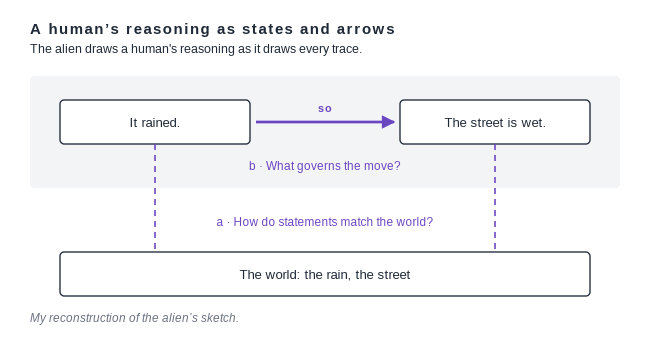
Figure 1. A human's reasoning drawn as states and arrows. The boxes raise the first question; the arrow raises the second. The figures are my reconstructions of the alien's sketches.
One afternoon the human held dark glasses to the slab's screen and turned them. The screen darkened. The human had asked the light a question, and the light had answered.
Translator's note. The glasses act as a linear polarizer. The screen's light is approximately linearly polarized; crossing the glasses' transmission axis with that polarization makes it much darker.
What governs the moves
The old computer let me study the second question directly. After every step it showed one of two conditions, green or red. That told me which moves the human's machine accepts.
After about two hundred sessions I had a one-page model that predicted every light I had seen. I had not yet found a case that told my model apart from the checker.
For the word and it had three arrows. Two take a statement apart: from "A and B" it lets the human write A, and it lets the human write B. One puts two together: from A and from B it lets the human write "A and B". It would not let the human attach any B it chose to A. That move lit red.
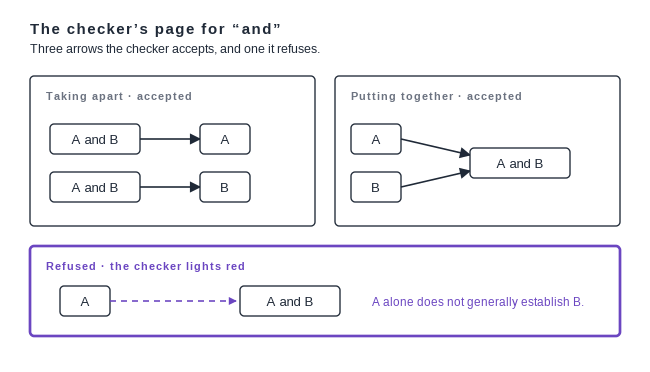
Figure 2. The checker's page for "and": three arrows it accepts and one it refuses.
I wanted to know why these three arrows and not others. I could think of one test. I ran each of the three arrows on every situation I could find. In each, when the lines going in held, the line coming out held.
Then the human surprised me. It asked the slab for a rule that would make every proof easy, and the slab produced a well-known one, which humans call tonk. Its putting-together arrow lets the human write "A tonk B" from A alone, for any B. Its taking-apart arrow lets the human write B from "A tonk B". The program stayed fixed, but its owner could edit the rule list. The human added both arrows.
It began with one equals one. From that it wrote "one equals one tonk one equals two." Then it took out "one equals two." Green at every step.
The human did not discuss what tonk meant. It looked at what came out. Any statement now followed from any other. It deleted the two arrows.
I remembered the backup checker. The agent had changed its verdict and stopped, satisfied. Here the human saw a green light and grew suspicious. It was the first time I had seen anyone refuse a green light. The human had also brought a test of its own: a statement it knew to be false by other means. Something had gone wrong. The starting line, the new arrows, their meaning, or the checker itself would have to be questioned.
I noted what the human had done. It judged an arrow by what came out of it. The arrows for and carried true lines to true lines. The arrows for tonk did not.
The chain of whys
There was a game the human played with the slab. It asked, "Why is this step allowed?" The slab named a rule. The human asked why that rule was allowed. The slab named another statement. The human asked again.
Each answer added a statement. None performed the step it described. I had crossed one wall by testing interpretations against the world. I did not yet know whether testing could answer this question too. The chain did not end because the slab ran out of answers. It ended when the human closed the lid and stood up.
Translator's note. Lewis Carroll told this as a dialogue between Achilles and the Tortoise in 1895. In a simplified version, the Tortoise accepts A and "if A then B" and still declines to infer B. Adding a statement that records the rule does not perform the step.
The four lines, explained
Now I could return to the light. I had both questions in hand and a place to try them.
My instruments could do more than the human's glasses. They could test light along any direction and could split a beam in two. This is what I found. Light I had prepared as horizontal passed the horizontal test every time. It passed the up-diagonal test about half the time; my model assigned that outcome probability one-half. When I split it along the diagonals, every flash left by the up exit or the down exit, never neither.
From these observations I built a model of polarized light, and within the model I could write four exact lines. By "certain to pass a test" I mean that the model assigns passage probability one. Observing only successful passages supports that prediction but does not establish it by itself. Beside each line I noted what it rests on, as my first question asks.
- The light is certain to pass the horizontal test. (Prepared that way.)
- The light will leave by one of the two diagonal exits, up or down. (Every flash did, and in my model every light must.)
- No light is certain to pass the horizontal test and also certain to pass the up-diagonal test, each tested separately on the same preparation. (In my model the two directions have no state in common.)
- No light is certain to pass the horizontal test and also certain to pass the down-diagonal test, each tested separately on the same preparation. (Likewise.)
Then I applied the old arrows, as my second question asks. In my reconstruction, I wrote line 2 using the checker's ordinary or: either the light is certain to leave by the up exit, or it is certain to leave by the down exit. I had not yet noticed that this said more than line 2. Suppose the first. Together with line 1, the light is then certain to pass both tests, and line 3 forbids that. Suppose instead the second. Line 4 forbids that. Either way, a contradiction. The checker would have lit green at every step.
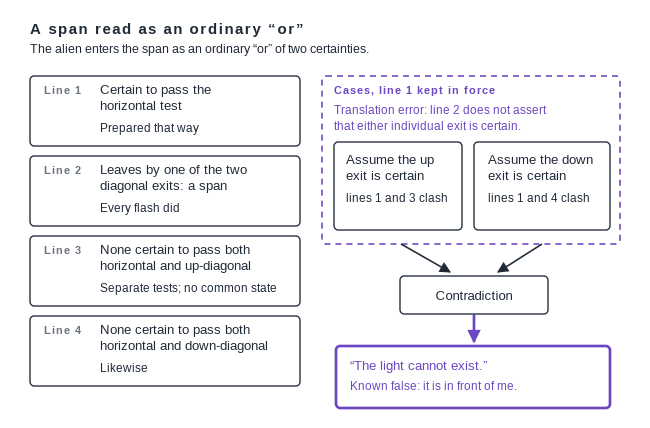
Figure 3. The four lines and the argument. Purple marks the unsupported translation of line 2 into an ordinary disjunction of two certainties.
The checker would have verified my argument. But my version said more than line 2 did. I had changed "one of these outcomes must occur" into "one particular outcome is certain."
I did not delete the arrow that reasons from an or by taking each alternative in turn, as the human had deleted tonk. For ordinary or, it remained valid; I had to correct my entry. If I wanted the same sign to mean the span of subspaces, I could not carry over the old arrows unchanged. I had to say which meaning I intended before asking which moves were allowed.
Translator's note. Write H, U and D for the horizontal, up-diagonal and down-diagonal polarization subspaces. A statement holds with certainty when the prepared state lies in its subspace. Line 2 is the span of U and D, which is the whole space, so it holds for every state. In a horizontal state, however, neither U nor D holds individually. It is not the ordinary disjunction "the up outcome is certain or the down outcome is certain", which fails for a horizontal light.
There are two ways to describe the mistake. In the checker's ordinary language, the alien supplied a stronger premise than the observations supported. If the same symbol is instead interpreted as the subspace join, the ordinary rule of proof by cases is not sound under that interpretation. Lines 3 and 4 say that H shares only the zero vector with U and with D, and no physical state is the zero vector; separate tests means separate runs on identically prepared photons, which is a different experiment from testing one photon twice in succession. This is the companion article's example:
, while . See Why ‘Or’ Works Differently in Quantum Mechanics and What Makes a Logical Step Valid?
Why the questions meet
I had treated the two questions as independent. They were not.
How I represented a statement affected which moves were safe. Tests could expose a failure, but successful tests alone could not establish a rule for every case. The second question could not be answered without the first.
The welcome had required two reports. So did this.
The first: the step matches the written arrows. The checker settles this every time, and it is the question the green light answers.
The second: the conclusion follows under the intended interpretation. I used ordinary reasoning to show that the checker's rule could not be carried over unchanged when or meant the span of polarization subspaces.
I added a warning of my own. I do not know which kind of statement most of my other reports contain. The people who built our own checker never met this light. And I still do not know who checks the check at the bottom. The human's test, a known falsehood, raised the alarm over tonk and over this light, but it cannot say where the test itself comes from.
I do not yet know whether my question was a good one. For the first time, though, I had understood why someone might refuse a green light. That showed me what checking was for.
Here the notebook ends.
After the notebook
The alien had not forgotten the birthday photos, and neither had I. The green lights are still on the old computer in the corner. They vouch for conformity to the written rules. They say nothing about whether the statements were true, or whether the steps suit the kind of statement the proof is about. I still have to check that myself.
I picked up the dark glasses from the table, held them to the screen and turned them a quarter turn. The screen went dark.
The dog got up and went to the door.
Further reading
- What Makes a Logical Step Valid?, the companion article: the argument behind the alien's four lines.
- Why ‘Or’ Works Differently in Quantum Mechanics, the photon and the three tilted lines.