Article · Math and Computer Science
The Dog at the Door
How does a machine, or anyone, make sense of the world?
Everything a machine receives is a stream of states and changes, and so is everything we receive. An alien with no dictionary shows how much of a world can be rebuilt from them. Watching reveals patterns. Learning what the patterns stand for takes testing them against the world, and acting gives the strongest tests.
An Alien’s Notebook, Part 1. The notebook continues in The Lost Birthday Photos, “I’m Glad You’re Here” and The Checker in the Corner.
The kitchen
I was sitting at my kitchen table, typing a question into my laptop. My dog lay under the chair, its chin resting on my foot. Across the room the washing machine hummed through a load of shirts. The box it came in had called it smart.
My question was about the dog: why does it follow me from room to room? While I waited for the answer, I looked down. The dog looked back. What, I wondered, was it thinking? Did it know anything about me, or only about my habits?
The answer appeared on the screen, clear and correct. I closed the laptop, stood and took the leash from its hook. At the rattle, the dog was at the door before I had taken a step.
I learned only later that I had not been the only one wondering. An alien had landed in my house some weeks before, unseen. When it went home, it left its notebook behind.
The same puzzle, for machines
The answer on my screen was good. But what connects a machine's words to the world? A camera hands a machine grids of numbers; a microphone hands it pressure readings; a language model receives a long string of symbols. Even when the symbols are words, receiving the word "cup" does not tell a machine what a cup is. Researchers often look for the connection in a world model, an inner picture of the world.
Our own senses are in the same position, though we rarely notice it. How much of a world can be built from nothing but states and changes? The alien's notebook is one long answer.
A note on this translation
The notebook is in no language we know. Its writer had orders to send home what each thing stands for, never human words, so it recorded states, changes and the structure between them. Structure alone would not have been enough: the alien's own argument, below, is that patterns do not say what they stand for. But the notebook describes my house. I could match its records to events I remembered: the leash on its hook, the washing cycle, the evening I asked the program to repair the backup. Where the matches held, I could translate.
Where the alien had no name for something, I use ours. The four-legged one by the door is the dog; by the same rule, people in general are "humans", and I am "the human". The figures are my reconstructions of its sketches.
Translator's note. Notes like this one, and the references at the end, are mine, not the alien's.
My assignment
I was sent to observe intelligent life on Earth and report home. Headquarters wanted to know which of the things in one house, if any, could think. Our scientists had proposed a test to begin with: a thing that thinks should carry a picture of its world, one that lets it anticipate what will happen next, and experience should be able to change that picture. They did not claim the test would settle the question.
My orders ended with a warning: "We do not know their words either. If you send us one of their words, it will mean nothing here. Send us what the word stands for."
What I can observe
I can observe only physical states and how they change: light and sound, warmth and pressure, the position of a part, the charge on a switch. My instruments record the physical details: changes in the dog's cells, switches in the laptop and turns of the washing machine's drum. But when I arrived I did not speak or understand human language, and I cannot look inside their heads to read what they mean. I can measure every cell in a brain without seeing a single thought.
So my instruments give me two things, and only two.
First, I can tell conditions apart. A light is on or off. A door is open or shut. Water stands above a line or below it. Each condition I can tell apart from the others I call a state.
Second, I can notice when one state gives way to another. The light goes off; the door swings shut. Each such change I call a transition.
My instruments give me no names, causes or purposes; those I must infer. I record states and transitions, one after another, and I call the record a trace. How much of a world can be rebuilt from a trace? More than I expected, it turned out, and less than I hoped.
The leash
One evening the human closed the laptop on the kitchen table and lifted a strip of leather from a hook. At its rattle, the dog was at the door before the human had taken a step.
A human would have read that at once: the dog expected someone to leave. I could not. I had every change in the dog's cells and no idea what any of it meant.
My plan: five steps
Three terms keep my notes straight. A representation is an inner state that stands for something outside. A world model is a set of representations that supports predictions about the world, including what would happen after an action. An adaptive world model can change with experience.
My work fell into five steps. The first three study an object alone: decide what counts as a state, record which state follows which and find the patterns in that record. Then comes a wall. An object's own trace shows its patterns but not what they stand for. The last two steps connect the object to the world: test interpretations of its states against what happens around it, then link the states to conditions in the world.
I began with three objects: an old computer in the corner that checked proofs, the washing machine and the dog. The checker ran a fixed program over a list of rules its owner could edit. It never revised those rules for itself. Later I turned to two more.
Step 1: Decide what counts as a state
My first discovery was that a state is partly my own choice. I could describe the computer switch by switch, or by a few large groups of switches. Too fine a description buried me in detail. Too coarse a description hid real differences.
A good description helps predict. Two histories count as the same state whenever they lead to the same predictions about the future. A state, in this sense, keeps everything about the past that matters for what comes later and nothing else.
Translator's note. James Crutchfield and Karl Young made this idea precise; their successors call such states causal states.
Even a good description leaves an enormous number of possible states. A computer with
Step 2: Record what follows what
Next I recorded which state followed which. A transition diagram shows the result: a box for each state and an arrow for each transition, labelled with whatever triggers it.
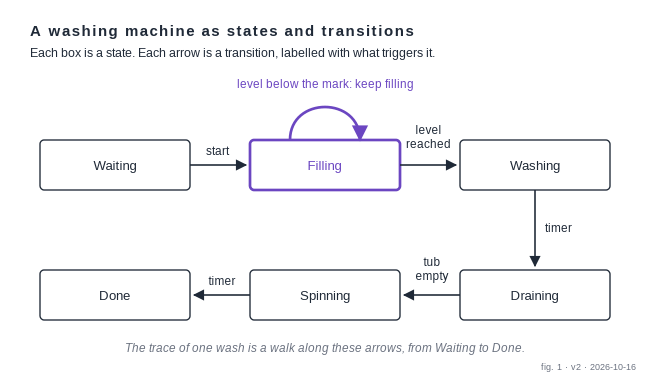
Figure 1. A washing machine as states and transitions. One arrow loops back: while the water is below the mark, the machine keeps filling.
The washing machine fits on one page. It waits until started, fills until a sensor reports that the water has reached its mark, washes, drains, spins and stops. One arrow loops back on itself: while the water is below the mark, the machine keeps filling. That loop was the first thing I saw in the house that corrected the world instead of only recording it.
Some transitions are certain: the timer always ends the wash. Others happen only with some probability, and then each arrow carries a likelihood. Either way, the diagram summarizes the trace. It says what can follow what.
Step 3: Find the structure
A diagram of the computer would have far too many boxes to draw. So I asked five questions of its trace instead.
- How surprising is the next state? I measured how hard each state was to guess from the states before it. If every switch flipped freely and at random, the surprise would be as large as it could be. The computer's was far smaller: something constrained the switches.
- Does it have a rhythm? I compared the trace with a copy of itself shifted by a small delay. A delay that makes the two line up is a rhythm. The computer had a clock. The dog had a heartbeat, a breathing rhythm and a daily cycle.
- Which parts move together? For each pair of parts, I asked how much knowing one told me about the other. Parts that inform each other suggest groups that work together, though two parts may also move together only because they share an input or a clock. I sketched the computer's likely groupings this way, without a wiring diagram.
- What holds still? Some groups settled into a value and stayed there until something flipped them. Holding a value until it is changed is what memory does.
- How short is its story? I squeezed the trace as hard as I could. The more a trace shrinks, the more repeating structure it contains. The computer's trace shrank enormously, as if a short rule produced it.
Translator's note. The first question measures what Claude Shannon called the entropy rate, the average surprise per step. The third measures mutual information. The last is what compression programs do, such as those built on the method of Jacob Ziv and Abraham Lempel.
One caution came out of this work. A long recording shows an object's habits (its clock, its layout, its memory) but not the particular job it is doing today. To separate the two, I had to watch on different days.
Then I went back through my recordings of the dog and found a surprise. The rattle of the leash had not always sent the dog to the door. A week earlier the sound had triggered nothing; since then the response had appeared and grown quicker each time. The dog's response to the same sound had changed: its experience had altered a stored association. The computer's rules and the washing machine's cycle did not change through experience.
Translator's note. This is the kind of learning Ivan Pavlov described in his studies of conditioned reflexes.
The dog also moved toward some smells and away from some shapes, as if it kept a private list of what is good and what is dangerous. It was my first hint of wanting.
The wall
After all this, I knew the three objects better than the human did, state by state. And I could not say what a single one of my findings stood for.
I had the computer's clock but not the number the computer held. I had the washing machine's cycle to the second but not the fact that the cycle ends in clean clothes. I had the dog's new response but not the fact that it means someone is about to leave.
The reason was simple. I had studied each object's own trace, and nothing in a trace points outside the object. Every pattern referred only to other patterns inside it. No interpretation had been tested a second way, so a real pattern could not be told from a lucky coincidence. And no interpretation had been checked against anything but my own guesses.
Worse, if meanings can be assigned freely, almost any trace can be made to fit.
Translator's note. Hilary Putnam argued that, under such free assignments, an ordinary rock can be described as running any simple program.
So I faced a wall. Studying the objects harder would give me a better map of the same closed rooms. To learn what the patterns stood for, I had to look beyond the objects.
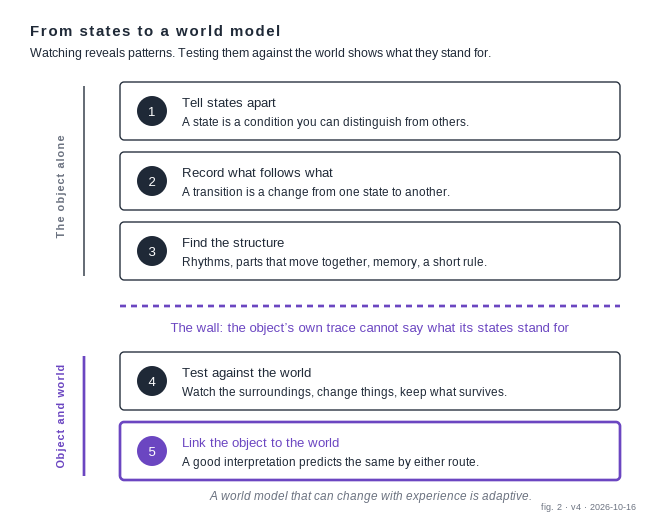
Figure 2. Where the alien stood. The first three steps study the object alone; the wall stops them; the last two connect the object to the world.
Step 4: Test against the world
I widened my view to take in each object's surroundings. The leash sound usually came just before the human put on a coat and left. The washing machine's float rose as the water in the tub rose. These pairings were real evidence, and I could test my guesses against what happened next, without touching anything.
But watching has a weakness. Two things can move together because one causes the other, or because some third thing drives both. A record made by watching often fits several different accounts of what causes what. Changing something myself could tell them apart.
So I also began to interfere. I pressed a button on the computer and watched which group of switches answered. My first interpretation, "this pattern means seven", failed the next day under slightly different conditions. I tried again, varying what I pressed and when, and kept only the interpretation that survived every change and also explained several other puzzles. I removed water from the washing machine in mid-fill and watched it fill for longer. I made the leash sound at odd hours and in odd rooms and watched the dog respond each time.
My method never changed: guess, test the guess against the world and keep only what survives. Watching the surroundings gave me tests. Acting gave me the strongest ones.
Translator's note. Judea Pearl showed when intervening can separate causal accounts that a passive record cannot. David Chalmers answered Putnam in a related way: a system really runs a program only if its states would follow the program's rules in situations that did not happen, as well as in those that did. Interventions create such situations.
Step 5: Link the object to the world
Now I could write down an interpretation. Picture two pages. One page holds the object's states and transitions. The other holds conditions in the world and how they change. An interpretation is a link from a state on the first page to a condition on the second.
Anyone can draw a link. One test of an interpretation is whether it preserves the relationships between changes inside the object and changes outside it.
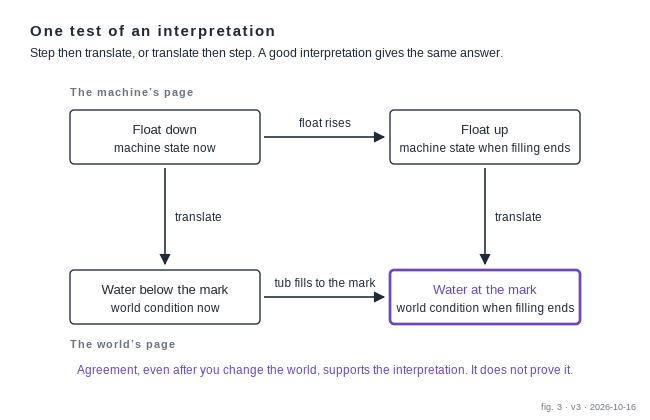
Figure 3. One test of an interpretation. Stepping the machine and then translating should give the same world condition as translating and then letting the world step.
Start from a state of the object. Step the object forward, then translate the result into a world condition. Or translate first, then let the world move forward. If both routes end at the same condition, including after I have changed the world myself, the interpretation gains support. In Figure 3 the washing machine's float rises when filling reaches the mark, and either route gives "water at the mark".
Translator's note. Mathematicians call such a pair of agreeing routes a commuting square.
Passing this test supports an interpretation; it does not settle it. Two different interpretations can preserve the same changes. If both pass every test I can run, nothing I can do will choose between them. And an interpretation that passes today can still fail tomorrow.
I also had to ask what each link was for. To call a representation wrong, I must say what it is supposed to get right. The computer's link to "seven" serves its makers: scramble it and the computer does not suffer; its users do. The dog's links serve the dog. Scramble the link between the leash sound and someone leaving, and it is the dog that is caught wrong-footed at the door.
So this is my account of meaning: an interpretation becomes a meaning by being tied to the world and surviving tests, and acting gives the strongest tests.
Translator's note. The results I cite in these notes support each part of the alien's account. They do not prove the whole of it.
Sending a meaning without words
Now I could obey headquarters' warning. The dog keeps a store of food energy, and humans have a word for the drive that makes it eat. That word would mean nothing at home. So I sent the structure instead: what the dog keeps steady, what disturbs it and what the dog does to restore it. From those three parts my readers could rebuild the meaning on their side.
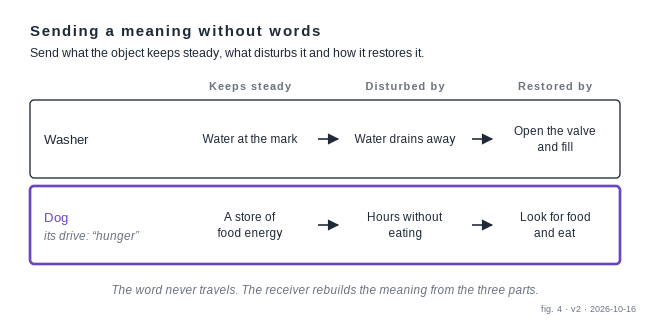
Figure 4. Sending a meaning without words. The receiver rebuilds the meaning from three parts: what the object keeps steady, what disturbs it and how it restores it.
This gave me the plainest account of communication I found in the house. A message works when the receiver can rebuild, on its side, what the sender's state was about.
Translator's note. The human word is hunger. The notebook's other structures were rebuilt the same way, and checked against my own house.
What makes a world model
I returned to headquarters' test. Does an object carry a picture of its world? I began with a simple test. Find a state inside the object that tracks a condition outside it, and check that the object uses that state to change what it does. A puddle reflects the sky, but it does nothing with the reflection, so it fails.
The washing machine passes. Its float tracks the water level and controls the valve. That makes the float a representation, but not yet a world model, because the machine predicts nothing. It reacts to the level it has; it never anticipates the level it will have.
Translator's note. Roger Conant and W. Ross Ashby proved that, under their assumptions, the best and simplest regulator of a system must mirror that system's structure. The theorem says something about structure. It does not settle whether a regulator understands anything.
The dog does predict. Its response to the leash sound arrives before anyone moves toward the door. Its stored associations tell it what will happen next.
Then I tested whether each model could change. I secretly reversed the washing machine's valve, so that "fill" drained the tub. The float dropped, the valve opened and the tub emptied further. The machine would have gone on forever. Its one link was built in at the factory, and nothing in the machine can change that link or add a second.
The dog added a link while I watched: a sound that meant nothing a week before now predicts someone leaving. So the dog has an adaptive world model: a set of representations that predicts what will happen, tested against the world, with room to change as the world changes.
The fourth object: a talking machine
By then I had begun to decode a little of human talk, by the same method I used on everything else: a sound, what followed it and whether the link held when conditions changed. I could follow a simple request, though not much more.
I thought I had seen the important differences. Then I looked again at the flat slab the human had been typing on in the kitchen. I had filed the laptop as one more computer, like the one in the corner. But this one answered in sentences.
Translator's note. We call the program inside it a language model. Its behavior was shaped by training on an enormous body of human writing and then by human feedback on its answers.
The human asked it questions, and it answered. Here, I thought, was the easiest object in the house. The others had to be decoded state by state. This one could simply say what it meant. Its answers were long and fluent, and the human seemed satisfied with them.
But each answer was itself a string of states. I still had to decide what those states were tied to, and the slab's fluency could not decide that for me. My confidence began to fade.
What it learned in training stays fixed, but it can use new information during a conversation, even picking up a new pattern from a few examples. When the conversation ends, that new information is normally gone. One day I watched the human tell the slab something specific; the next day, in a fresh conversation, the slab had forgotten it. (Some users now give the slab a notebook it can carry from one conversation to the next.) The trained slab, as I picture it, is like a very large book that reading does not change.
Where did its links to the world come from? The humans who wrote its training text made them, by writing about things they had seen, touched and tested. The slab inherits those links through their words. That alone does not set it apart, since humans inherit most of their meanings too. The question is whether a system can use, test and revise what it inherited. The slab uses its inherited links fluently. It cannot seek new evidence on its own, though new observations that humans give it can test its predictions. An inherited link can also mislead it: an answer may fit a familiar pattern of words while failing to match the world.
Translator's note. We call this hallucination. Researchers still argue about how much of the world a machine can learn from text alone.
Then humans gave the slab hands, by which I mean access to tools. A thin shell of ordinary software calls the slab again and again, carries out its instructions, passes back the results and keeps notes. Inside the shell the slab acts, sees what happened and corrects course. Tools let it seek independent evidence and intervene directly, on the task it was given. Some such systems also store skills that worked, in files they can reuse later. I recorded what changes and what stays fixed: the trained core stays fixed, while the conversation, the notes and the stored skills change.
The fifth object: a machine that does science
I also examined a machine built to find physical laws. It did not talk. It studied simulated experiments and wrote down relationships that held.
Translator's note. This is AI-Newton, built by physicists at Peking University. The laws it arrived at are Newton's second law of motion and his law of gravitation.
It worked through simulated experiments on balls, springs and slopes. It proposed concepts, looked for relationships that survived new tests and revised rules when they failed. It rediscovered familiar mechanics, including Newton's second law and gravitation.
Then I looked at what its builders had supplied: objects such as balls and springs, measurements such as position and time, and restrictions on the forms a proposed law could take. The simulated world already followed the laws the machine found.
It had discovered relationships inside a supplied framework. It had not invented the framework itself.
How humans cross the wall
Humans build their own world models from the same raw material. Their senses report changes in light, sound, pressure and warmth: states and transitions. Yet they rarely notice the wall, because they cross it by shortcuts. They understand their machines because they built them; whoever wired a button to mean "seven" wrote that down for the rest. They understand the dog partly because they resemble it: they share its kind of body and know from the inside what it is to be hungry. And they understand each other because they were told. Long before a child could work out a meaning alone, someone pointed at a thing and said its name.
The talking slab leaves them without several of these shortcuts. They built its training but not what it became, so nothing written down says what any pattern inside it means. They share no body with it. They can ask it, in their own language, but its account of itself is only partly tied to what happens inside it.
Their view of the world, then, is a model built from states and transitions, and most of its meanings were handed to them rather than earned. What keeps those meanings honest is that they can still test and revise them. Take the shortcuts away and a human would be left with my method: watch, connect, test and keep what survives.
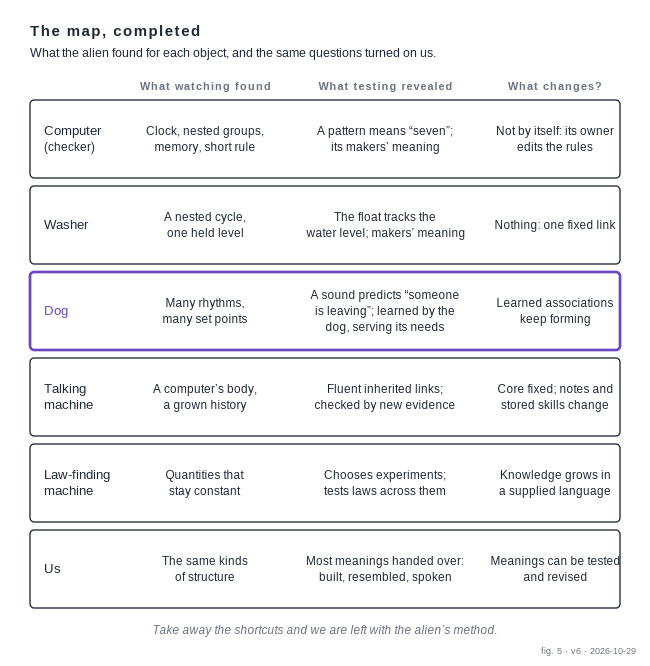
Figure 5. The map, completed. What watching and testing revealed for each object, and the same questions turned on us.
The dog kept revising associations through its own experience. The agent could also revise its working picture through observations, notes and stored skills, while its trained core remained fixed. The law-finding machine expanded its knowledge within a language its builders supplied. Learning was not one property that a whole kind of object either had or lacked.
After the notebook
I never needed any of this to know why my dog went to the door. But my shortcuts do not reach the program on my laptop. The alien's method shows how an observer can investigate a world model, not how a machine must learn one. It left me with five questions to ask when someone says that a machine understands the world.
- What counts as a state for it, and who chose?
- Does it find structure, or does it only store what it was shown?
- Have its interpretations been tested against the world, and has it tested them by acting?
- What is each link supposed to get right, and who pays when it is wrong?
- Can it revise what it inherited as the world changes?
The notebook goes on. The alien next asks what the machines in my house want, in The Lost Birthday Photos, whether a machine in my house can feel, in “I’m Glad You’re Here”, and what justifies a step of reasoning, in The Checker in the Corner.
I lifted the leash from its hook, and the dog was at the door before I took a step.
Further reading
- Chalmers, D. J. (1996). Does a rock implement every finite-state automaton? Synthese, 108(3), 309–333. https://doi.org/10.1007/BF00413692
- Conant, R. C., & Ashby, W. R. (1970). Every good regulator of a system must be a model of that system. International Journal of Systems Science, 1(2), 89–97. https://doi.org/10.1080/00207727008920220
- Crutchfield, J. P., & Young, K. (1989). Inferring statistical complexity. Physical Review Letters, 63(2), 105–108. https://doi.org/10.1103/PhysRevLett.63.105
- Fang, Y.-L., Jian, D.-S., Li, X., & Ma, Y.-Q. (2025). AI-Newton: A concept-driven physical law discovery system without prior physical knowledge. arXiv:2504.01538. https://arxiv.org/abs/2504.01538
- Garg, S., Tsipras, D., Liang, P., & Valiant, G. (2022). What can transformers learn in-context? A case study of simple function classes. arXiv:2208.01066. https://arxiv.org/abs/2208.01066
- Ha, D., & Schmidhuber, J. (2018). World models. arXiv:1803.10122. https://arxiv.org/abs/1803.10122
- Ji, Z., Lee, N., Frieske, R., Yu, T., Su, D., Xu, Y., Ishii, E., Bang, Y., Madotto, A., & Fung, P. (2023). Survey of hallucination in natural language generation. ACM Computing Surveys, 55(12), 1–38. https://doi.org/10.1145/3571730
- Ouyang, L., Wu, J., Jiang, X., et al. (2022). Training language models to follow instructions with human feedback. arXiv:2203.02155. https://arxiv.org/abs/2203.02155
- Pavlov, I. P. (1927). Conditioned Reflexes (G. V. Anrep, Trans.). Oxford University Press.
- Pearl, J. (2009). Causality: Models, Reasoning, and Inference (2nd ed.). Cambridge University Press.
- Putnam, H. (1988). Representation and Reality. MIT Press.
- Shalizi, C. R., & Crutchfield, J. P. (2001). Computational mechanics: Pattern and prediction, structure and simplicity. Journal of Statistical Physics, 104(3–4), 817–879. https://doi.org/10.1023/A:1010388907793
- Shannon, C. E. (1948). A mathematical theory of communication. Bell System Technical Journal, 27(3), 379–423. https://doi.org/10.1002/j.1538-7305.1948.tb01338.x
- Wang, G., Xie, Y., Jiang, Y., Mandlekar, A., Xiao, C., Zhu, Y., Fan, L., & Anandkumar, A. (2023). Voyager: An open-ended embodied agent with large language models. arXiv:2305.16291. https://arxiv.org/abs/2305.16291
- Ziv, J., & Lempel, A. (1978). Compression of individual sequences via variable-rate coding. IEEE Transactions on Information Theory, 24(5), 530–536. https://doi.org/10.1109/TIT.1978.1055934