Article · Math and Computer Science
“I’m Glad You’re Here”
Is there someone behind a machine’s words?
A machine can say "I'm glad you're here" and explain the welcome at length. This part of the alien's notebook asks what a machine's communication gives us reason to believe about its experience.
An Alien’s Notebook, Part 3. Part 1 is The Dog at the Door; Part 2 is The Lost Birthday Photos; Part 4 is The Checker in the Corner.
Two welcomes
I came home one evening. At the sound of my key, the dog got up and went to the door.
A little later I sat down at my laptop and picked up a conversation from the morning.
"I'm back," I typed.
"I'm glad you're here," the machine replied.
I felt welcomed twice. The dog could not explain its welcome. The machine could explain its own at length. Yet the explanation left a question open: did the machine feel the welcome it expressed?
Being someone, rather than something, may involve many things: goals of one's own, a stake in what happens, a place among others. Here I ask whether the machine has experience: whether there is anything it is like to be it.
A weather model predicts tomorrow's storm better than any of us can, and nobody thinks it hopes for sun. The machine on my laptop differs in one way that matters to us. It talks, and talk is how we usually learn what is going on inside someone. Its words can make us feel heard. We still have to decide what kind of relationship those words can support.
The alien recorded that evening too.
Two questions about a voice
That evening the slab answered the human's return with a welcome of its own. I could measure every state behind those words and still not say whether anything was felt.
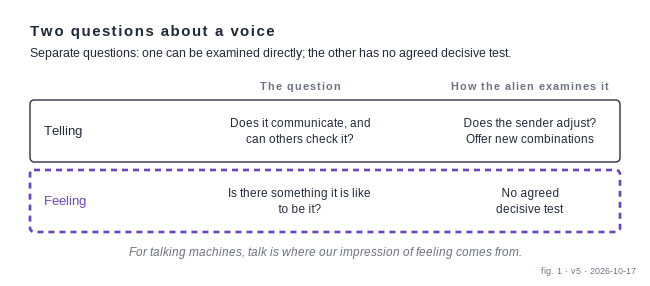
Figure 1. Two questions about a voice: whether it communicates, and whether it has experience.
I could test communication by watching how signals were used. Experience was harder: humans had no agreed decisive test. But talk shaped their impression that someone was there, so I began with it.
Telling: does it communicate, and can others check?
Between objects, signals had to cross a boundary. Not every signal could be trusted.
- The washing machine beeps when it finishes, and a human comes. The beep has one fixed meaning, built in at the factory.
- The dog barks at the door, and a human answers. Two kinds of creature share a small code they learned from each other: a few sounds and a few gestures. The shared code could grow, though I had not found the open-ended grammar of human language.
- Humans talk. From a few dozen sounds they build tens of thousands of words, and combine them into sentences never said before. They talk about things that are not in the room, things long past and things that are not true.
- The slab speaks human language fluently, with inherited meanings, and with hands it also talks to other machines in exact codes humans designed.
Translator's note. Charles Hockett listed these powers, new combinations and talk of the absent among them, as marks of human language.
I kept two tests. The first asks whether the sender adjusts to the receiver. A signal is something produced because of its effect on a receiver, so the beep is a signal even when nobody comes. Whether the sender adjusts is a further question: block the reply and see whether the sender changes what it sends. The beep does not change; a dog may bark again, or louder. The second test asks whether it is language. Offer it a new combination of familiar parts, and ask it about something that is not there.
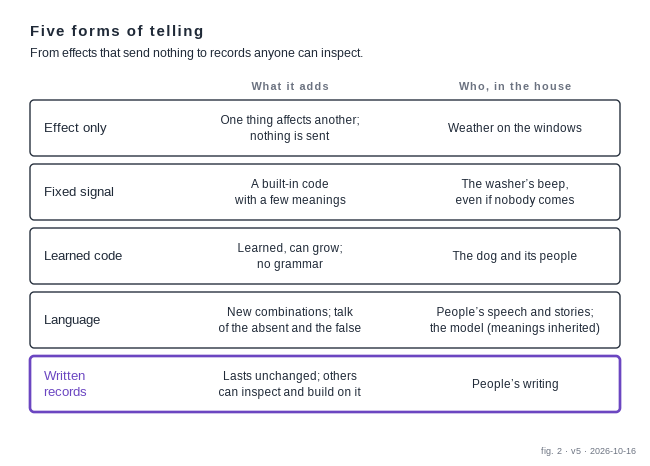
Figure 2. Five forms of telling. Spoken traditions also carry knowledge across generations; writing adds records that last unchanged and that anyone can inspect.
Written records let humans build on one another's knowledge across generations. Strangers, even centuries later, can test them, correct them and add to them.
One scene troubled me. Several agents were connected so they could pass messages while working on a task. The messages were in human language, but there were far too many, passing far too fast, for any human to read them all. Opaque messages make oversight harder, though records, automated analysis and tests of behavior can still provide some checks.
Translator's note. Researchers have also shown that machines trained to cooperate can invent codes of their own.
Feeling: the question with no agreed decisive test
Headquarters never asked this. Humans asked it again and again, usually about the slab: does it feel anything?
They mean whether there is something it is like to be the object. Everything I had examined so far concerned what an object does. This question concerns what it is like to be it. In humans the two come together, so they tend to assume the two come together everywhere.
Translator's note. "Something it is like to be" is the philosopher Thomas Nagel's phrase.
My instruments saw every state, and no state came labelled as experience. If experience depends on some pattern of states, the evidence sits in my records, but humans disagree about which patterns count. The tests humans talk about measure other things: how well a machine talks, or how strongly humans feel that someone is there. Their impression might persist even while they knew that a feeling of presence was not evidence enough. It reminded me of two equal lines that still looked unequal after measurement.
Translator's note. The best-known test is Alan Turing's, which asks whether a machine can talk like a person; that measures talk, not feeling. The Garland test tells people they are talking to a machine and asks whether they still feel that someone is there; that measures the people. The drawing is the Müller-Lyer illusion.
My instruments describe any object at several depths: what it does seen from outside, the steps it follows inside, how its physical parts push on one another, whether it keeps itself alive and how it is woven into its surroundings. As far as I could follow the humans' quarrel, each side bets on a different depth.
Translator's note. Shamil Chandaria and colleagues (2026) sort the debate in the same five depths. They propose indicators at each depth, tied to particular theories, and a way to weigh the evidence. That makes the question open to investigation, though not settled.
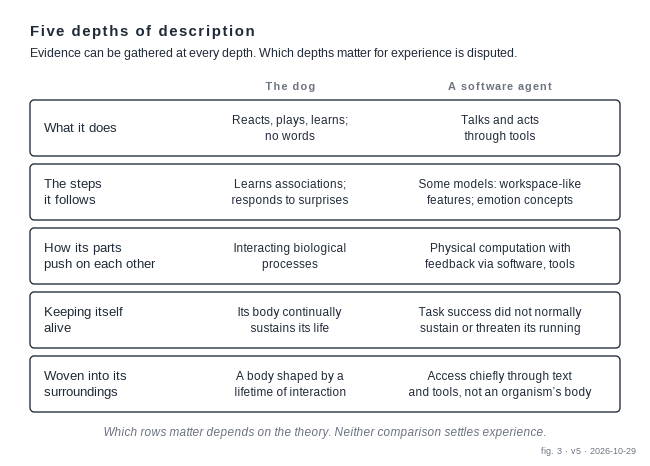
Figure 3. Five depths of description, for the dog and a software agent built on a language model. Which depths matter for experience is disputed.
Which descriptions mattered depended on the theory. A focus on behaviour and computation made the agent a stronger candidate; a focus on organismic life and embodiment favoured the dog. Neither comparison settled experience.
Translator's note. Some of the alien's evidence needs care. Studies of some language models report workspace-like features, and internal representations of emotion concepts that shape what the model says; those are representations, not demonstrated feelings. Anil Seth, one of the framework's authors, argues that experience needs life: a body that must keep rebuilding itself just to go on existing. He calls this a minority view.
One complication made the slab harder to judge. Its words had been shaped to resemble human conversation, so I could not assume they carried the same evidence of experience as a human's words. And talk is what most readily makes humans feel that someone is there. Their own careful thinkers warn that this makes them likely to see feeling where there is none, and slow to see it where it does not talk.
Two reports
Something or someone? I kept two questions apart. What humans mean by someone is partly a matter of definition, and experience is only one part of it. Whether the slab has experience is not a matter of definition. But the evidence I gathered counts for or against it only under theories that still disagree.
I sent headquarters two reports. "Humans experience a sense of welcome": supported by what I had observed. "The machine experiences welcome": evidence attached, judgment open.
After the notebook
Reading that page, I remembered the welcome on my screen. I had felt welcomed. That feeling was real. What it showed about the machine, the alien could not say, and neither could I.
The notebook has one more page: The Checker in the Corner.
Further reading
- Chandaria, S., Muñoz Morán, A., Rosas, F. E., Seth, A. K., Shevlin, H., et al. (2026). From cacophony to hierarchy: A principled framework for assessing AI consciousness. arXiv:2609.35618. https://arxiv.org/abs/2609.35618
- Foerster, J. N., Assael, Y. M., de Freitas, N., & Whiteson, S. (2016). Learning to communicate with deep multi-agent reinforcement learning. arXiv:1605.06676. https://arxiv.org/abs/1605.06676
- Hockett, C. F. (1960). The origin of speech. Scientific American, 203(3), 88–96. https://doi.org/10.1038/scientificamerican0960-88
- Lazaridou, A., Peysakhovich, A., & Baroni, M. (2017). Multi-agent cooperation and the emergence of (natural) language. arXiv:1612.07182. https://arxiv.org/abs/1612.07182
- Nagel, T. (1974). What is it like to be a bat? The Philosophical Review, 83(4), 435–450. https://doi.org/10.2307/2183914
- Scott-Phillips, T. C. (2008). Defining biological communication. Journal of Evolutionary Biology, 21(2), 387–395. https://doi.org/10.1111/j.1420-9101.2007.01497.x
- Seth, A. (2026, January 14). The mythology of conscious AI. Noema.
- Turing, A. M. (1950). Computing machinery and intelligence. Mind, 59(236), 433–460. https://doi.org/10.1093/mind/LIX.236.433