Article · Physics
Why "Or" Works Differently in Quantum Mechanics
Classical physics represents events as sets; quantum physics represents them as subspaces. With subspaces, the familiar distributive rule for "and" and "or" can fail.
The difference in brief
Popular treatments of quantum mechanics use phrases such as "an electron in two places at once" and "wave-particle duality" to describe quantum behavior. These phrases alone do not explain how quantum mechanics makes predictions. The geometry of its state space gives a clearer account.
Classical physics deals with events as sets. An event, such as "the particle is in the left half of the box", is the set of states in which it happens. A probability measure assigns each set a probability, and the overlap of two sets represents both events happening together.
Quantum physics deals with events as subspaces of a space that has length and angle. The state of the system is an arrow in that space. The probability of an event is computed by projecting the arrow onto the event's subspace: it is the squared length of the arrow's shadow.
This difference has many consequences. Figure 1 sets the two pictures side by side; the rest of the article develops three of them:
- "or" is no longer a union, and the distributive law of ordinary logic can fail;
- a pure state can belong to the combined event without belonging to either alternative;
- amplitudes can reinforce or cancel, so a superposition differs measurably from a random mixture of the same alternatives.
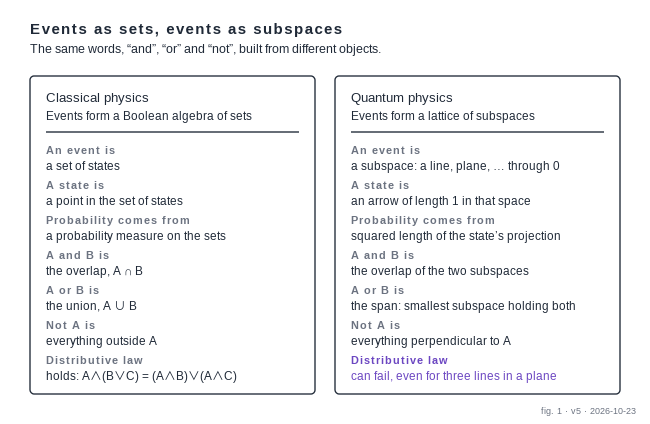
Figure 1. The same three words, built from different objects. The bottom row is the first consequence.
Events as sets
A classical system is in one state, a point in a set of possible states. A yes/no question, such as "is the particle in the left half of the box?", defines an event: the set of states for which the answer is yes. We use the two words interchangeably. A and B is the overlap of two such sets, A or B their union, and not A everything outside A. These definitions give the distributive law:
A and (B or C) = (A and B) or (A and C).
A point in A and in the union of B and C lies in A and B, or in A and C. An exact classical state gives a definite answer to every question: the point lies inside the set or outside it.
When the exact state is unknown, classical mechanics assigns probabilities: a measure that gives each set a number between 0 and 1, gives the whole space 1, and adds for sets that do not overlap. The probability of "A and B" comes from the overlap. Probability rests on the sets; it does not change how questions combine.
A photon and its state
For the quantum case we study the polarization of a single photon: horizontal, vertical or tilted across the beam. A polarizing filter passes a photon polarized along its direction and blocks one polarized perpendicular to it.
We represent the photon's state by an arrow of length 1 in a flat plane, pointing along the polarization direction. This plane is not the space we live in. It is an abstract space of states, where the angle between two arrows tells how likely a photon in one state is to pass a test for the other. (For photons the arrow follows the filter's orientation, a convenience of this case; the electron-spin article shows a state space that does not.)
Keep three things apart: the state (how the photon was prepared), the question (the test we apply) and the outcome (pass or block on one trial). Probability connects the state to the outcomes of the chosen test. This article concerns how questions combine; combining states is superposition, a different operation.
We assume a pure state (one unit arrow, which can still give random outcomes), ideal filter tests, and linear polarization, which fits on a flat plane.
Events as subspaces
In quantum mechanics an ideal question is represented by a subspace: a set of arrows closed under addition and stretching, in a space where lengths and angles are defined. Its unit arrows represent the pure states for which the answer is certainly yes. It has this structure because a test certain to say yes for two states is certain to say yes for any nonzero linear combination of them, rescaled to length 1. In our plane the subspaces are the lines through the origin, the whole plane, and the origin alone.
A physical state is a unit arrow, so that its probabilities add to 100%, while a subspace contains all stretched copies of its own arrows. Normalizing a nonzero sum changes its length, not its direction, and membership in a subspace, or perpendicularity to it, depends only on direction.
Two special subspaces remain. The whole plane is the question that always gets yes. The origin alone, the zero subspace, holds no arrow of length 1, so no physical state lies in it: it always gets no.
Probabilities from projection
For a unit state arrow, the Born rule gives the probability that a question answers yes: 1 if the arrow lies in the subspace, 0 if it is perpendicular, and otherwise the squared length of the arrow's shadow on the subspace, cos²φ for the angle φ between arrow and line. The probability of no is the remainder.
The shadow has a sign as well as a length. For a filter line, that signed projection is the amplitude for passing the filter, and the probability is its square. Arrows add by adding their shadows, so when states are combined their amplitudes add, and amplitudes, unlike probabilities, can cancel. (In the plane used here amplitudes are signed numbers. In general they are complex numbers with a phase, and the signs ± are the phases 0° and 180°.)
Prepare a photon horizontally and send it through a filter turned by φ from horizontal. It passes with probability cos²φ: 100% at 0°, 50% at 45°, 0% at 90°. Classical polarized light obeys the same law for intensity; for a single photon it is a probability.
Here the two pictures part. A classical state fixes the answer to every ideal question, and probability enters only through our ignorance of the state. A quantum state, even when completely specified, generally fixes only probabilities.
First consequence: "or" is a span
For subspaces the three connecting words mean:
- A and B is the overlap: the arrows in both subspaces, the states for which both questions are certainly yes.
- Not A is the set of arrows perpendicular to every arrow in A.
- A or B is the span: every arrow built by adding stretched copies of arrows from A and from B. It is the smallest question that is certainly yes for every state that makes A certain and for every state that makes B certain.
A union cannot serve as or: a sum of one nonzero arrow from each of two different lines lies on neither line, so the union is not a subspace.
Every span defines an ideal yes/no question. For two perpendicular lines, that question groups the outcomes of one measurement, so one of them always occurs and their probabilities add. For the horizontal question H and the +45° question, which are not perpendicular, it is the trivial test that accepts every polarization state and says nothing about which was prepared. It does not combine the results of the two filter tests: a vertical photon passes the H filter with probability 0 and the +45° filter with probability ½. Sharing only the zero arrow does not make alternatives exclusive; perpendicularity does.
Three lines in a plane
Take three questions: H (horizontal) and the two tilted lines, +45° and −45°. Figure 2 draws them. Compute "H and (+45° or −45°)" directly. The two tilted lines span the whole plane, the question that always gets yes, and H and "always yes" is H.
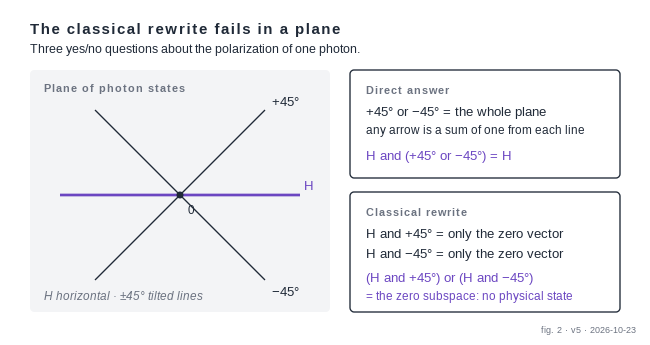
Figure 2. The classical rewrite of "H and (+45° or −45°)" gives a different result for subspaces.
Now try the classical rewrite, "(H and +45°) or (H and −45°)". The only arrow on both H and +45° is the zero arrow, so "H and +45°" is the zero subspace, and so is "H and −45°". The zero subspace or the zero subspace is the zero subspace. The direct computation gives H; the rewrite gives the zero subspace. For sets the two always agree, so the rewrite is not a valid step for subspaces. The expressions are different questions: for a horizontal photon the first is certainly yes and the second certainly no.
"H and +45°" is the overlap of the two subspaces, not "measure H, then measure +45°". A horizontal photon can pass a +45° filter with probability one-half without contradicting the zero overlap: a measurement can change the state, but the overlap asks whether one state could answer yes to both questions with certainty. None can.
Second consequence: a pure state in an "or" but in neither part
Suppose the photon is horizontally polarized. Ask "is it +45° or −45°?" by measuring along the tilted lines. These lines are perpendicular, so they are the two outcomes of one measurement, and the answer is always yes. Yet "is it +45°?" gets yes only half the time, and so does "is it −45°?". The horizontal state lies in the span without lying in either line, which is impossible for a point in a union of sets.
The horizontal arrow is a linear combination of a +45° arrow and a −45° arrow (each scaled by 1/√2 to keep the length 1). Relative to the two tilted states, the horizontal state is a superposition: it lies in their span without lying in either.
The span combines questions and defines "or"; a linear combination combines states and defines superposition.
Classical probability also allows a certain "or" with uncertain alternatives: "heads or tails" is certain although each has probability one-half. The difference here is geometrical. The state is completely specified, and it lies in the span but in neither line.
Third consequence: amplitudes reinforce or cancel
A superposition is not uncertainty about which tilted state was prepared, and a test shows the difference. Compare photons prepared horizontally with photons prepared at random, half at +45° and half at −45°. A measurement along the tilted lines gives the same results for both: half +45°, half −45°. Now test fresh photons from each preparation with a horizontal filter and with a vertical one (Figure 3).
The horizontal arrow is the sum of a +45° arrow and a −45° arrow, each scaled by 1/√2, so its amplitude for any filter is the sum of two contributions, one from each tilted arrow. (These are the two terms of the calculation; no polarization is measured along the way.) For the horizontal filter they are +½ and +½. They add to 1, and every photon passes. For the vertical filter they are +½ and −½. They cancel, and no photon passes. For the random mixture, each tilted state is prepared half the time and passes either filter half the time, so each contributes ½ × ½ = ¼. Probabilities only add, and half the photons pass either filter. The two preparations agree on one test and disagree on another, and the disagreement is interference.
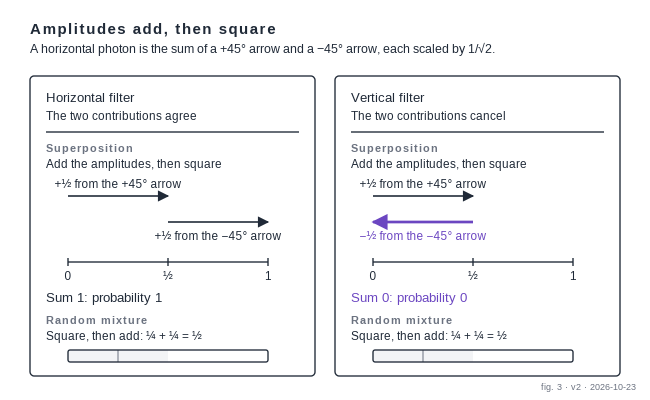
Figure 3. Separate horizontal and vertical filter tests distinguish a pure horizontal state from an equal mixture of the two tilted states.
The coherent preparation requires adding amplitudes before squaring; the random mixture requires adding weighted probabilities. For identical electrons an additional rule reverses the sign of the amplitude when the electrons are exchanged. Together with amplitude addition, that rule leads to the Pauli exclusion principle, the subject of Why Two Electrons Cannot Share a State.
Where the classical picture survives
Mathematicians call the two structures a Boolean algebra and a lattice of subspaces. Birkhoff and von Neumann (1936) proposed the latter as "the logic of quantum mechanics"; whether it rivals ordinary logic is disputed, and we use only the mathematics.
Two questions are compatible if one can be measured without disturbing the other's outcome statistics. Compatible questions form an ordinary system of sets, a "classical window": H and vertical share one, +45° and −45° another. The distributive law holds inside a window and can fail across windows.
Back to "or"
In ordinary logic, "or" is a union: a point in it belongs to at least one part. In quantum theory, "or" is the span of the alternatives. For perpendicular alternatives the span is the question that one of them occurs, and it also contains their superpositions, so a horizontal photon belongs to "+45° or −45°" without being in either state.
Four companion articles continue the story. Electron Spin: Opposite in Space, Perpendicular in State Space develops the abstract state space, Bell's Theorem: Testing Answers Written in Advance asks whether answers fixed in advance could explain measurement results, What a Quantum Computer Actually Does shows how interference becomes a computing resource, and Why Two Electrons Cannot Share a State derives the exclusion principle from interference.
References
- R. P. Feynman, R. B. Leighton and M. Sands, The Feynman Lectures on Physics, Vol. III, ch. 1, "Quantum Behavior", and ch. 4, "Identical Particles".
- G. Birkhoff and J. von Neumann, "The logic of quantum mechanics", Annals of Mathematics, 2nd series, 37(4) (1936) 823–843.
- H. Putnam, "Is logic empirical?", in R. S. Cohen and M. W. Wartofsky (eds.), Boston Studies in the Philosophy of Science, vol. 5 (Dordrecht: Reidel, 1969) 216–241.