Article · Physics
Electron Spin: Opposite in Space, Perpendicular in State Space
Spin up and spin down point in opposite directions in space, yet they are perpendicular in the space of states; the reason is that angles in the state space are half the angles in space.
A puzzle about angles
Take an electron whose spin is "up" along some axis, and one whose spin is "down" along the same axis. In ordinary space these are opposite directions, 180° apart, like the north and south poles of a globe. In the abstract space where a quantum state is an arrow, the two states are perpendicular, 90° apart. Why does an angle of 180° in space become 90° in the space of states? The answer is a single rule, and it shows concretely why the space of states is not the space we live in. We use the quantum picture of the article on "or": an event is a subspace of an abstract space, a state is an arrow in it, and the probability of the event comes from projecting the arrow onto the subspace.
The measurement
In the Stern–Gerlach experiment (1922) a beam of silver atoms, whose spin is that of one electron, passes through a magnet and splits into two beams. The magnet defines an axis, and the result is always one of two outcomes: spin up or spin down along that axis. Tilt the magnet to a new axis and the result is again one of two outcomes, now along the new axis. We treat the electron as the standard example of such a two-outcome system. The state is how the electron was prepared, the question (or event) is "up along this axis?", and the outcome is up or down on one trial.
Two facts about electron spin are all we need:
- One axis, two exclusive outcomes. Along any chosen axis, "up" and "down" exclude each other: an electron measured as up along z will be measured as up along z every time, and never as down.
- A tilted axis gives probabilities. Prepare an electron up along z, then measure along an axis tilted by an angle θ from z. The probability of "up" along the new axis is cos²(θ/2), and of "down" is sin²(θ/2).
- Tilt 0° (same axis): 100%.
- Tilt 90° (z to x): 50%.
- Tilt 180° (up z to down z): 0%.
The factor ½ inside the cosine is the whole story.
Drawing the state as an arrow
A state is an arrow of length 1, an ideal yes/no question is a subspace (here a line), and the projection rule gives the probability of "yes" as the squared length of the arrow's shadow on the line. If the angle between the state arrow and the line is φ, that probability is cos²φ.
Now ask which arrows reproduce the spin probabilities. We need cos²φ = cos²(θ/2), so φ = θ/2. The angle between the arrows is half the angle between the axes in space. We keep the tilt within one plane, so a flat sheet is enough; tilts in all directions need a richer description.
The consequences are shown in Figure 1:
- Up z and up x are 90° apart in space, but their arrows are 45° apart. The probability 50% is cos²45°.
- Up z and down z are 180° apart in space, and their arrows are 90° apart. They are perpendicular, as the two outcomes of one measurement must be.
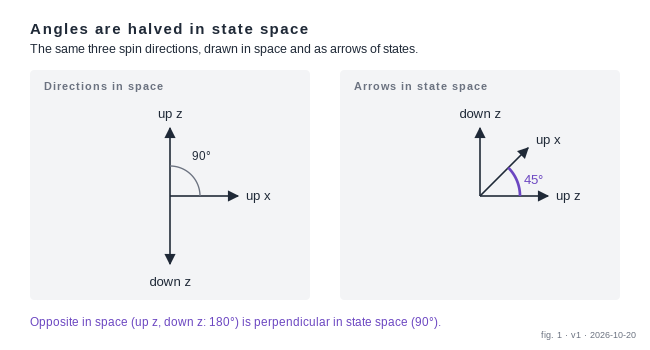
Figure 1. The same three spin directions drawn in space (left) and as arrows of states (right). Angles on the right are half the angles on the left.
So the plane of spin states is not physical space. The same three directions appear in both panels, but at different angles, because the right-hand picture measures how likely one state is to pass a test for the other, not where anything points.
Photons are different
For photon polarization, a filter turned by 45° corresponds to a state arrow turned by 45°. The angles are not halved, and horizontal and vertical polarizations, 90° apart in space, are 90° apart as arrows. This is why the photon plane looked like physical space. It is a feature of that case, and the electron shows that it does not carry over. This article does not derive why the two cases differ; that needs more of the theory than we have used.
A full turn
Turn the measurement axis through 360° in space. The state arrow turns through 180°, so it ends up pointing the opposite way along the same line. The line is the yes/no question, so the question returns exactly after a full turn, as it should. Reversing the entire state arrow leaves all its spin-measurement probabilities unchanged. Flipping the sign of the whole state is invisible. Changing one component's sign relative to another is not: it decides whether contributions add or cancel, as the article on quantum computing shows.
The same failure of "or"
Events as subspaces bring the same consequence for spin as for photons. Take "up along z", "up along x" and "down along x". The last two are perpendicular lines, so "up x or down x" is the whole plane, and "up z and (up x or down x)" is "up z". But "up z and up x" and "up z and down x" are both the zero subspace, so the classical rewrite gives the zero subspace. For an electron prepared up along z, the first expression is certainly yes and the second certainly no. The distributive law fails for spin as it did for photons.
Back to the puzzle
Opposite directions in space become perpendicular arrows in state space because a physical angle θ corresponds to a state-space angle φ = θ/2, and the probability is cos²φ. The space of states has its own geometry, set by the probabilities of measurement results, and it is not the geometry of the room.
References
- W. Gerlach and O. Stern, "Der experimentelle Nachweis der Richtungsquantelung im Magnetfeld", Zeitschrift für Physik 9 (1922) 349–352.
- R. P. Feynman, R. B. Leighton and M. Sands, The Feynman Lectures on Physics, Vol. III, Chapter 6, "Spin One-Half".