Article · Physics
Why Two Electrons Cannot Share a State
Two identical particles reach one outcome in two ways that cannot be told apart, so their amplitudes add. For electrons, exchange reverses the sign of the amplitude, and the contributions cancel when both would occupy the same complete state: that is the exclusion principle.
The wall
Press your hand against a wall. The electrons in your fingers repel those in the wall, but repulsion is not the whole answer. An orbital is the spatial part of an electron's state, and two electrons can share one orbital if their spins are opposite. A third electron must occupy a different orbital.
What keeps it out is a rule: no two electrons can be in the same complete state, spatial part and spin together. This is the Pauli exclusion principle, which Wolfgang Pauli formulated in 1925. It is usually stated and seldom explained.
This article derives it, following Feynman (Lectures on Physics, Vol. III, ch. 4), from two ingredients: amplitude addition, from the article on "or", and the minus sign associated with exchanging two electrons. Figure 1 is the map.
Two ways to one outcome
Two particles, a and b, are scattered, and two counters, 1 and 2, wait for them. We ask for the outcome "both counters click". It can happen in two ways. In the direct way, particle a goes to counter 1 and b to counter 2, with amplitude A. In the exchanged way, a goes to counter 2 and b to counter 1, with amplitude B.
Suppose the particles can be told apart, say one is painted red. Then the two ways are different outcomes, and their probabilities add. With A = 0.3 and B = 0.2 the probability is 0.09 + 0.04 = 0.13.
Now suppose the particles are identical, like two electrons, and assume they also have the same spin state, so spin provides no distinguishing label. Nothing, even in principle, tells the two ways apart. There is one outcome with two amplitudes, and the amplitudes are added before squaring. The exchanged amplitude carries an exchange factor, and the factor matters, because two amplitudes can reinforce or cancel.
The factor is plus or minus one
What can the factor be? Feynman's argument is short. Exchanging the roles of the two particles multiplies the amplitude by the factor. Exchanging them again must give back the original situation, so the factor applied twice must equal 1. Only two numbers have a square equal to 1: +1 and −1.
Both cases occur in nature. Particles whose exchanged amplitude is added are bosons; photons are bosons. Particles whose exchanged amplitude is subtracted are fermions; electrons, protons and neutrons are fermions. For our numbers, bosons give (0.3 + 0.2)² = 0.25 and fermions give (0.3 − 0.2)² = 0.01, against 0.13 for particles that can be told apart.
Why electrons carry the minus sign is a separate matter. Pauli proved in 1940, with quantum field theory and relativity, that particles of half-integer spin are fermions and those of whole-number spin are bosons. Feynman says he cannot give an elementary explanation. Here we take the sign as given.
When the contributions cancel
Now take an example in which the direct and exchanged contributions are equal: A = B = 0.3.
- Particles that can be told apart: 0.09 + 0.09 = 0.18.
- Bosons: (0.3 + 0.3)² = 0.36, twice as large.
- Fermions: (0.3 − 0.3)² = 0, exactly.
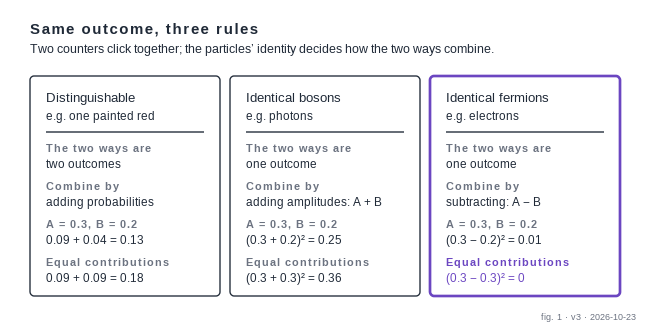
Figure 1. The same outcome under three rules. For fermions, equal contributions cancel exactly.
Now suppose both electrons would occupy the same complete one-particle state: the same direction, the same energy and the same spin. Electrons with opposite spins are in different states. In the same state the direct and exchanged contributions must be equal, and for fermions their opposite signs make the total amplitude zero: A − A = 0. That is the exclusion principle: two identical fermions cannot be in the same complete state. The cancellation requires no interaction between the particles. For bosons the equal contributions add, and in this idealized comparison two bosons are twice as likely to end in the same state as two particles that can be told apart. The cause is interference, the same adding of arrows as in the article on "or", where +½ and −½ cancelled at the vertical filter.
What the rule builds
Feynman asks what the world would look like if only this one rule were changed. Hydrogen, with one electron, would be unaffected. If electrons were bosons, the electrons of helium and lithium would all occupy the lowest orbital, and the familiar pattern of shell filling and chemical properties would disappear.
An electron's state is a spatial orbital together with one of two spin states. The two electrons of helium occupy the lowest orbital with opposite spins. Lithium's third electron cannot join them: both spin states of that orbital are taken, so it must occupy a higher orbital, farther from the nucleus (Figure 2), where it is loosely bound. Removing an electron takes about 25 electron volts from helium but only about 5 from lithium (Feynman). That difference is the beginning of chemical valence, and the periodic table follows the same pattern.
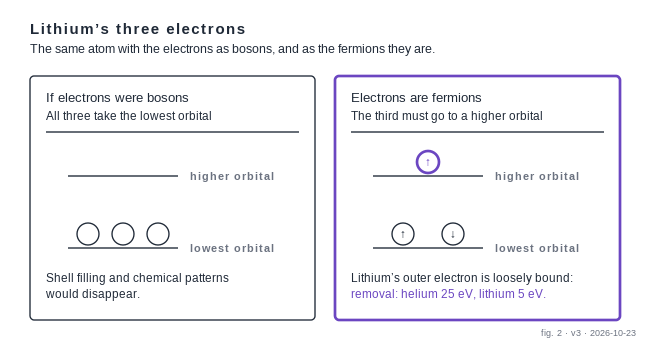
Figure 2. Lithium's three electrons and the orbitals they occupy. Bosons would all take the lowest orbital; fermions cannot.
The rule also gives matter its size. Pressing two atoms together asks their electrons to share orbitals. Each orbital takes only two electrons, with opposite spins, so the rest must move into higher-energy orbitals, and that costs energy. Part of what you feel as the wall is this cost.
Bosons behave differently: they can share a state. For photons, emission into an already occupied mode is enhanced, and this stimulated emission is central to how a laser works.
Back to the wall
The chain is short. Identical particles cannot be told apart, so the two ways to one outcome interfere. Exchanging twice restores the state, so the exchange factor is +1 or −1. For fermions it is −1, and when both particles are in the same complete state the two amplitudes cancel: arrows of equal length pointing opposite ways. The cancellation is the exclusion principle, and the principle gives atoms their shells, chemistry its variety and matter its size.
References
- R. P. Feynman, R. B. Leighton and M. Sands, The Feynman Lectures on Physics, Vol. III, ch. 4, "Identical Particles", sections 4-1, 4-2 and 4-7.
- W. Pauli, "Über den Zusammenhang des Abschlusses der Elektronengruppen im Atom mit der Komplexstruktur der Spektren", Zeitschrift für Physik 31 (1925) 765–783.
- W. Pauli, "The connection between spin and statistics", Physical Review 58 (1940) 716–722.