Article · Physics
Bell's Theorem: Testing Answers Written in Advance
A counting argument limits the probabilities of photon-pair results if the photons carry answers fixed in advance, and quantum mechanics predicts results outside that limit.
The experiment
The article on "or" contrasts events as sets, with a probability measure, and events as subspaces, with probabilities from projection. Bell's theorem puts that contrast to work on an experiment with pairs of photons.
Two photons leave the same source and travel toward distant measuring devices. At each device, an experimenter chooses the angle of a polarization filter and records yes (the photon passed) or no. Could the pair have left with instructions determining both answers? Agreement when the angles match seems easy to explain that way. Bell's theorem shows how measurements at different angles can test this explanation, provided neither result depends on the distant setting and the settings are chosen independently of the instructions.
Each run measures one photon pair, once on each side. As an idealized example, we choose an entangled polarization pair for which measurements at the same angle always agree. One pure state, a single arrow in a larger space, describes the pair as a whole; neither photon alone has a pure polarization state of its own. Entangled pairs differ in their correlation patterns, and we use only this one. Each observer alone sees pass and fail equally often; the correlation appears only when the two records are compared. Over many runs the experimenters try every combination of the angles 0°, 30° and 60° on similarly prepared pairs. No pair is ever measured at all three angles.
The proposed explanation
Picture each pair leaving the source with a card listing three entries: pass or fail at 0°, at 30° and at 60°. Both photons carry the same card, which would explain why they agree whenever the angles match. A card is a point in a set of states, as in the classical picture: it determines a definite answer to every question at once. Nobody can read a whole card, since each photon reveals only one entry. But if the cards exist, the results from different runs are entries drawn from one underlying table, and that is what lets us compare them.
Three assumptions are involved:
- Answers in advance. Each pair carries such a card, whether or not anyone measures it.
- Locality. The result at one device does not depend on which angle is chosen at the distant device.
- Independent choice. The angles are chosen independently of whatever is written on the cards.
The second and third assumptions are what let results from different settings be read as entries of one table. Matching cards explain the agreement at equal angles. But that agreement alone does not distinguish the card model from quantum mechanics, which predicts the same agreement.
A counting inequality
In the set picture, an event is the set of cards for which the answer is yes, and its probability is the weight the model gives those cards (their share, if all cards are equally likely). Let A be the set of cards whose 0° entry is pass, B those whose 30° entry is pass, and C those whose 60° entry is pass. "A and not B" means the cards with pass at 0° and fail at 30°. Its probability can be estimated from repeated measurements: send one photon through the 0° filter and its partner through the 30° filter, and count the runs where the first passes and the partner fails. The partner's 30° result stands in for the first photon's own 30° entry.
Now count. Take any card with pass at 0° and fail at 60°, that is, in "A and not C". Its 30° entry is either pass or fail. If it is pass, the card is in "B and not C". If it is fail, the card is in "A and not B". So every card counted in "A and not C" is also counted in at least one of the other two groups, and
P(A and not B) + P(B and not C) ≥ P(A and not C).
This set form is known as the Wigner–d'Espagnat inequality, after Eugene Wigner and Bernard d'Espagnat. Bell gave the same counting argument, with socks in place of cards, in 1981. Only ordinary counting is involved, the logic of sets applied to cards; the physics enters through the three assumptions that let us count cards.
What quantum mechanics predicts
For the prepared pairs, the first photon passes a filter at angle a with probability ½. Given that it passes, the partner's probabilities are those of a photon polarized along a, so by the projection rule (the squared length of the state's shadow) the partner fails a filter at angle b with probability sin²(a − b), where sin² means the square of the sine of the angle. The probability of both events is therefore ½ sin²(a − b). Since sin²30° = ¼ and sin²60° = ¾:
- 0° against 30°: ½ × ¼ = ⅛ = 12.5%.
- 30° against 60°: ½ × ¼ = ⅛ = 12.5%.
- 0° against 60°: ½ × ¾ = ⅜ = 37.5%.
The inequality requires 12.5% + 12.5% to be at least 37.5%. It is not: 25% is less than 37.5%.
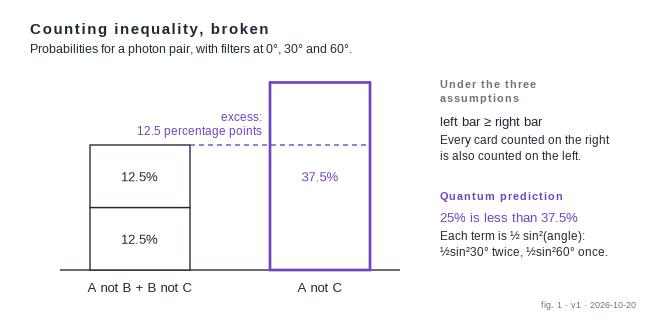
Figure 1. For a photon pair with filters at 0°, 30° and 60°, the quantum probabilities break the counting inequality by 12.5 percentage points.
What follows
The card model assigns probabilities to overlapping sets of cards, and the inequality holds whatever weights are chosen. Quantum mechanics computes probabilities by projection, and for these angles no weights reproduce its predictions. For any one chosen pair of settings, the four outcomes still have ordinary probabilities that add to one. The disagreement concerns whether the possible answers at all settings can share one underlying table. The conclusion is conditional: no model satisfying all three assumptions together can reproduce the quantum predictions. Counting itself is not at fault: ordinary counting remains valid. A model in which a result may depend on the distant setting is not excluded. Which assumption to give up is a matter of debate that this article does not settle.
Real experiments do not test this three-angle example directly. They test related inequalities, in forms suited to the apparatus. Aspect, Dalibard and Roger (1982) switched the filter angles rapidly during the photons' flight, to address locality. In 2015 three experiments, one with entangled electron spins and two with entangled photons, addressed the main loopholes of earlier tests, locality and detection efficiency, with the settings chosen by fast random generators. All observed violations of the relevant inequalities. Because real data are finite samples, such experiments must also show that the observed violation is too large to be a statistical fluctuation.
A companion article, Why "Or" Works Differently in Quantum Mechanics, develops the contrast between events as sets and events as subspaces behind the prediction above.
References
- J. S. Bell, "On the Einstein Podolsky Rosen paradox", Physics Physique Fizika 1(3) (1964) 195–200.
- E. P. Wigner, "On hidden variables and quantum mechanical probabilities", American Journal of Physics 38(8) (1970) 1005–1009.
- B. d'Espagnat, "The quantum theory and reality", Scientific American 241(5) (1979) 158–181.
- J. S. Bell, "Bertlmann's socks and the nature of reality", Journal de Physique Colloques 42(C2) (1981) C2-41–C2-62.
- A. Aspect, J. Dalibard and G. Roger, "Experimental test of Bell's inequalities using time-varying analyzers", Physical Review Letters 49 (1982) 1804–1807.
- B. Hensen et al., "Loophole-free Bell inequality violation using electron spins separated by 1.3 kilometres", Nature 526 (2015) 682–686.
- M. Giustina et al., "Significant-loophole-free test of Bell's theorem with entangled photons", Physical Review Letters 115 (2015) 250401.
- L. K. Shalm et al., "Strong loophole-free test of local realism", Physical Review Letters 115 (2015) 250402.