Article · Math and Computer Science
What Makes a Logical Step Valid?
Rules of inference play the part of laws of motion for reasoning, and, as in physics, they are best understood through what they preserve and what structure constrains them.
Rules we rarely question
A central aim of deductive logic is to preserve truth as we move from one proposition to another: if the premises hold, a licensed conclusion should hold too. This article asks what stands behind that guarantee.
If rain reaches the street, the street gets wet. Rain reached it, so it is wet. We take the step without noticing that a rule carried us.
We check premises all the time: we test data, check sources, argue about assumptions. We rarely check the rules, because they feel like thinking itself. Yet a conclusion is only as good as two things, the statements we began with and the rules that moved us from one statement to the next.
So why should a rule be trusted? Physics asks a similar question about its laws of motion, and it has three connected ways of looking: at the equations of motion, at what the motion conserves, and at the symmetries behind it. This article looks at logic in the same three ways. The map is:
- The moves. Which steps are allowed.
- What the moves preserve. The property no allowed step may lose.
- What constrains the moves. The structure behind that property.
The parallel is an analogy, not a derivation. It organizes the explanation and does not carry the argument. We say below where it holds and where it does not.
Three views of a physical theory
Equations of motion say which change of state is allowed. Given the forces and the initial position and velocity, Newton's second law, force equals mass times acceleration, determines a rock's subsequent motion.
Conservation laws name a quantity that stays constant along motions: energy, momentum, angular momentum. Each is conserved under the corresponding physical conditions, not for every system. Conservation laws constrain the solutions, and they give a shortcut: know the quantity at the start and you know it later, without following the path. They also work as a test. A machine that creates energy from nothing is rejected without inspecting its parts.
Symmetries are changes that leave the laws looking the same. In theories described by an action, Noether's first theorem (1918) connects suitable continuous symmetries of that action to conservation laws. Time-translation symmetry yields energy conservation, spatial-translation symmetry yields momentum conservation, and rotational symmetry yields angular-momentum conservation, under the theorem's assumptions.
Equations of motion, conservation laws and symmetries are different ways of understanding a theory. Conservation laws constrain its solutions, while Noether's theorem connects suitable symmetries of its action to conserved quantities. Neither symmetries nor conservation laws generally determine the full dynamics. See Conservation Laws and Symmetry.
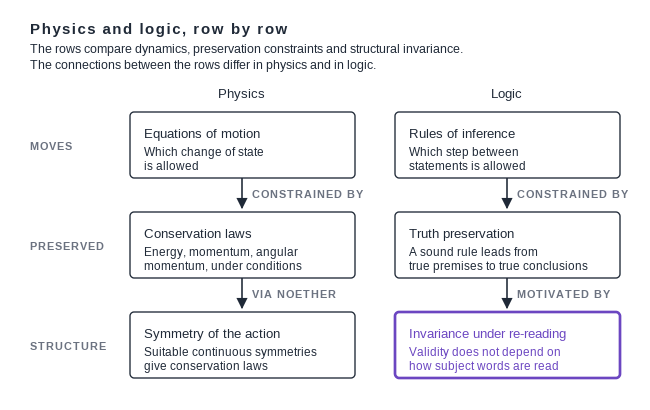
Figure 1. Physics and logic compared row by row. The connections between the rows differ in the two columns. Purple marks the row where the analogy needs the most care.
Three views of logic
Think of statements as the states of a system and of rules as its moves. A statement is a claim about a situation. A rule is a permission: if you have established statements of these forms, you may infer a statement of that form. A derivation is a chain of such steps. A semantics says what a statement is and when it holds in a situation. We need the word "holds" rather than "true or false", because in some of the semantics below a situation may make neither A nor "not A" hold.
The moves
"From 'A and B', infer A." "From A, infer 'A or B', for any B." These are the rules of inference, the laws of motion of reasoning.
What the moves preserve
The constraint is truth preservation. A rule is sound if, in every interpretation where all its premises hold, its conclusion holds too. This resembles preservation of an invariant property, but it is not conservation of a numerical quantity or equality of truth values. Conjunction elimination is sound, yet if A is true and B is false, then "A and B" is false while A is true. The guarantee runs one way: from true premises to a true conclusion. A fitting picture is a region of states that a motion never leaves. The statements that hold in a situation are closed under the sound rules.
Truth preservation works as a test. In 1960 Arthur Prior invented a connective, "tonk", with two rules: from A infer "A tonk B", for any B; and from "A tonk B" infer B. Chain them and any statement is derivable from any statement, as Figure 2 shows. Wherever A holds and B does not, the combined rules carry a true premise to a false conclusion, so they are unsound for any semantics admitting such a case. Tonk does not make a false statement true. It permits arbitrary conclusions without adequate grounds. The perpetual motion machine is a limited metaphor: a design that breaks conservation of energy is rejected without inspecting its parts, and tonk is rejected by what its rules permit, without inspecting its meaning.
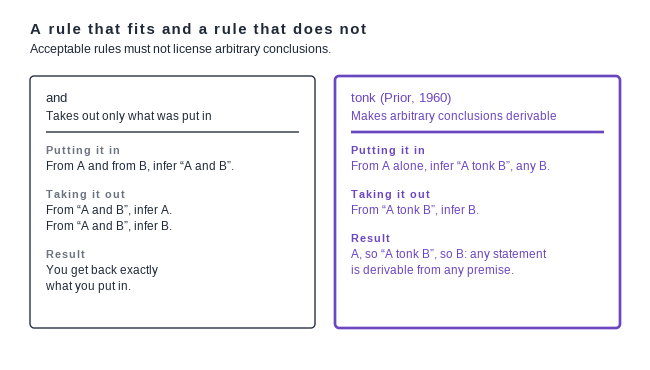
Figure 2. A rule that fits and a rule that does not. With tonk, any statement is derivable from any premise.
Truth preservation also gives a shortcut. If the premises hold and every step correctly applies a sound rule, the conclusion holds without a separate empirical check.
A semantics determines a consequence relation, not a unique list of primitive rules. Different calculi can capture that same relation, and a derivable step need not be a primitive rule. For classical first-order logic, Gödel's completeness theorem (1930) establishes that every semantic consequence is derivable in the standard calculi. Not every semantic consequence relation admits a sound and complete effectively axiomatized calculus.
What constrains the moves
Take the rule "from 'A and B', infer A". It works whether A and B are about rain, prime numbers or photons. An argument is semantically valid when every admissible structure satisfying its premises also satisfies its conclusion (Tarski 1936). The interpretations of the nonlogical symbols vary, including the domain of objects, while the logical vocabulary keeps its specified interpretation. Informally, we can say that validity survives every re-reading of the subject words.
This motivates a comparison with symmetry: valid inference is independent of particular interpretations of the nonlogical vocabulary. Where physics asks which changes leave the laws looking the same, logic asks which changes leave the step working.
Two questions must be distinguished. A definition of consequence asks which conclusions hold in every model of their premises. A criterion of logicality asks which expressions or operations should count as logical and therefore retain their interpretation across those models. Permutation invariance is one proposal for answering the second question.
Tarski offered it in the spirit of Klein's Erlangen programme, which defined a geometry by the changes that leave its properties unchanged. In a talk given in 1966 he suggested that a notion is logical if it is unchanged by every shuffling of the objects in the domain. "All", "some", "and" and "not" pass this test. "Is red" and "is prime" do not, because shuffling the objects changes which of them are red or prime. On this proposal, logical notions remain invariant under the full permutation group of the domain. The proposal is debated: Bonnay (2008) surveys the objections and offers a variant.
Where the parallel is weaker. In physics, Noether's theorem is a conditional proof about theories with an action. In logic, three ideas are related but not interchangeable: truth preservation across admissible interpretations, uniform treatment of the nonlogical vocabulary, and permutation invariance as a criterion for logical notions. The schema "from A, infer B" treats its subject matter uniformly, yet it is not valid. A permutation criterion for logical notions does not by itself select a consequence relation or a proof system. The distinction matters in both subjects. Conservation along a physical trajectory differs from invariance under a transformation. Likewise, preserving holding in one interpretation differs from preserving it in every admissible interpretation. Permutation invariance, as a criterion of logicality, addresses a further question.
Change the foundation, change the rules
Physics shows what a change of structure does. Galilean transformations give ordinary velocity addition: for motion along the same direction, the velocities add. Lorentz transformations instead give relativistic velocity addition. Let
At speeds much smaller than
Logic has a similar sensitivity. What is preserved is holding, and what "holds" means depends on what we take a statement to be. Figure 3 compares two representations.
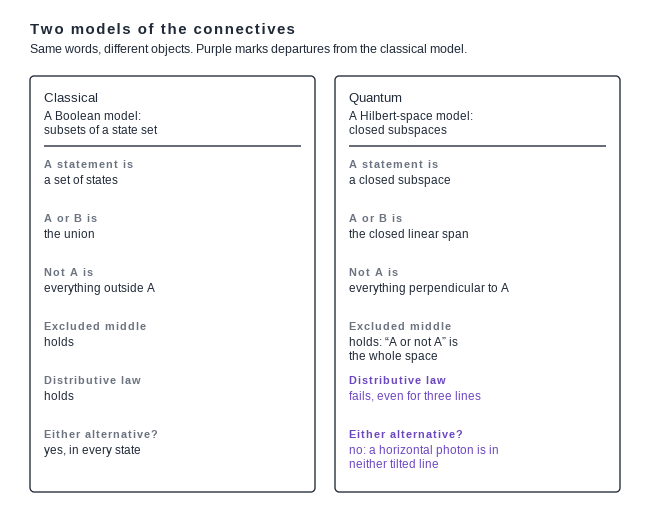
Figure 3. Two representations of propositions and their connective operations. Purple marks departures from the classical column.
Sets of states (classical). A statement is a set of states, and it holds in the states inside the set. "And" is the overlap, "or" is the union, "not" is everything outside. Every classical rule preserves holding.
Subspaces (quantum). A statement about a photon's polarization is a subspace of its state space, and it holds with certainty when the state vector lies in it. "And" is the shared part, "or" is the span (the smallest subspace containing both), and "not" is everything perpendicular. Here "A or not A" is the whole space, so it always holds, but a state can lie in neither A nor "not A". A fair coin gives a rough illustration of certainty without a certain result: it certainly lands heads-or-tails although neither result is certain. The subspace calculation below supplies the mathematics (Birkhoff and von Neumann 1936).
The law that falls
One everyday rule is proof by cases under a standing assumption:
If A guarantees "B or C", and A together with B guarantees D, and A together with C guarantees D, then A guarantees D.
Classically this is how we prove that "A and (B or C)" gives "(A and B) or (A and C)". It holds for sets of states. It fails for subspaces.
Let H be the horizontal polarization line in a plane, and U and D the two diagonal lines. Together U and D span the whole plane, so H guarantees "U or D". Now H shares only the zero vector with U, and only the zero vector with D, so in each case we have the zero subspace, which no state satisfies. Call it Z. Each case guarantees Z. But H does not guarantee Z: a horizontal photon lies in H and in no zero subspace. The entailment premises are true, but the entailment conclusion is false, so the rule does not preserve truth for subspaces. In symbols,
The comparison with velocity addition is limited but useful: changing the mathematical structure changes which relationships hold. It is not an experiment refuting classical logic. We proved the failure using ordinary classical reasoning about subspaces. See Why ‘Or’ Works Differently in Quantum Mechanics.
Other systems
Classical logic and the quantum example are only two choices, picked here to keep the argument short. Other logics alter the interpretation of the connectives, the consequence relation, or the structural rules governing assumptions. Intuitionistic logic, which grew from Brouwer's 1908 doubts about excluded middle for statements about infinite collections, does not accept "A or not A" as a general law (Heyting 1930; Moschovakis). Relevance logic requires the premises of a step to bear on its conclusion (Mares). Paraconsistent logics resist explosion: a contradiction among the premises does not make everything follow. Priest (2008) is a textbook survey of these and several more. Each answers the questions of this article differently.
The limit of further justification
In a simplified reconstruction of Lewis Carroll's 1895 dialogue, the Tortoise accepts "A" and "if A then B" but refuses to conclude B. Told to add the premise "if A, and if A then B, then B", it accepts that too and still refuses. Each premise added needs a further rule to be used. Carroll's point is that a rule cannot be justified by adding it to the premises: at the bottom a rule is used, not stated.
Physics can test its choice of symmetries against experiment. Logic has no agreed counterpart. Carnap argued that the choice of a linguistic framework is a matter of purpose, and Putnam (1969) argued that quantum physics might bear on logic itself. Both are contested.
What the parallel does not show
- It is an analogy, not a derivation. Noether's theorem is a conditional proof about theories with an action. Logic has theorems about parts of its picture, such as soundness of particular systems and Gödel's completeness for classical first-order logic. The comparison presented here does not derive a logical calculus from symmetry alone.
- Classical logic is not refuted. The quantum counterexample is proved with classical reasoning. Whether our own reasoning has a uniquely justified status is disputed.
- Experiments do not test modus ponens directly. Bell tests and the Kochen–Specker theorem constrain particular models of quantum systems, not an inference rule.
- The choice of semantics is open. A subject matter does not by itself fix its logic. Physics chooses symmetries partly by experiment; what plays that role in logic is the open question.
Back to the step
Within a calculus, a step is licensed by its rules. Relative to a semantics, it is valid when its conclusion holds in every admissible interpretation satisfying its premises. Soundness connects the calculus to that consequence relation.
The physics comparison highlights a shared concern with preservation and structural constraints. It does not derive logical rules from a conservation law. Choosing and justifying a semantics remains part of the philosophical problem.
References
- E. Noether, "Invariante Variationsprobleme", Nachrichten von der Gesellschaft der Wissenschaften zu Göttingen, Mathematisch-Physikalische Klasse (1918) 235–257. English translation by M. A. Tavel, arXiv:physics/0503066.
- K. Gödel, "Die Vollständigkeit der Axiome des logischen Funktionenkalküls", Monatshefte für Mathematik und Physik 37 (1930) 349–360.
- A. Tarski, "Über den Begriff der logischen Folgerung", Actes du Congrès International de Philosophie Scientifique, vol. 7 (Logique), Actualités Scientifiques et Industrielles 394 (Paris: Hermann, 1936) 1–11.
- A. Tarski, "What are logical notions?" (lecture of 1966), ed. J. Corcoran, History and Philosophy of Logic 7 (1986) 143–154.
- D. Bonnay, "Logicality and invariance", Bulletin of Symbolic Logic 14(1) (2008) 29–68.
- L. E. J. Brouwer, "De onbetrouwbaarheid der logische principes", Tijdschrift voor Wijsbegeerte 2 (1908) 152–158.
- A. Heyting, "Die formalen Regeln der intuitionistischen Logik I", Sitzungsberichte der Preußischen Akademie der Wissenschaften, Physikalisch-Mathematische Klasse (1930) 42–56.
- J. Moschovakis, "Intuitionistic Logic", Stanford Encyclopedia of Philosophy, ed. E. N. Zalta, https://plato.stanford.edu/entries/logic-intuitionistic/ (first published 1999; substantive revision 16 December 2022).
- E. Mares, "Relevance Logic", Stanford Encyclopedia of Philosophy, ed. E. N. Zalta, https://plato.stanford.edu/entries/logic-relevance/ (first published 1998; substantive revision 13 November 2020).
- G. Priest, An Introduction to Non-Classical Logic: From If to Is, 2nd ed. (Cambridge: Cambridge University Press, 2008).
- G. Birkhoff and J. von Neumann, "The logic of quantum mechanics", Annals of Mathematics, 2nd series, 37(4) (1936) 823–843.
- A. N. Prior, "The runabout inference-ticket", Analysis 21(2) (1960) 38–39.
- S. Kochen and E. P. Specker, "The problem of hidden variables in quantum mechanics", Journal of Mathematics and Mechanics 17(1) (1967) 59–87.
- L. Carroll, "What the Tortoise said to Achilles", Mind 4(14) (1895) 278–280.
- R. Carnap, "Empiricism, semantics, and ontology", Revue Internationale de Philosophie 4(11) (1950) 20–40.
- H. Putnam, "Is logic empirical?", in R. S. Cohen and M. W. Wartofsky (eds.), Boston Studies in the Philosophy of Science, vol. 5 (Dordrecht: Reidel, 1969) 216–241.
- A. Hindy, “Why ‘Or’ Works Differently in Quantum Mechanics”, keep2learning.com (2026), https://keep2learning.com/articles/quantum-logic-hilbert-space-vs-sets/.