Article · Math and Computer Science
Where "And" and "Or" Come From
Take the relation "A entails B" as the only starting point, and "and" and "or" are determined by it; classical, intuitionistic and quantum logic then differ in the further structure that the ordering has.
Two logics, one question
Two earlier articles set classical and quantum propositions side by side. Why ‘Or’ Works Differently in Quantum Mechanics showed that a classical question is a set of states and a quantum question is a subspace, and that "or" is a union in one case and a span in the other. What Makes a Logical Step Valid? asked what a rule of inference must preserve.
This article asks whether the two pictures are instances of one structure. To a large extent they are, and the structure is an ordering of propositions. The map is:
- The order. Propositions, with "A entails B" as the one relation.
- Meet and join. "And" and "or" read off from the order alone, wherever the order has them.
- Three orderings. Sets of states, open sets of a space, subspaces of a Hilbert space.
- What differs. Complements, distributivity, and implication.
- What remains open. Why an ordering by entailment should govern reasoning at all.
This is a statement of standard lattice theory, with the physics as one application. We do not claim that every logic is of this kind.
Start from entailment
Write A ≤ B for "whenever A holds, B must hold", and read it "A entails B". If the temperature is above 30 °C, it is above 20 °C, so "above 30" ≤ "above 20".
Two properties are enough to begin. Every proposition entails itself (A ≤ A, reflexivity). And entailment chains: if A ≤ B and B ≤ C, then A ≤ C (transitivity). A relation with these two properties is a preorder. If we treat two propositions that entail each other as the same proposition, we get a partially ordered set: some pairs are comparable, and some are not.
Keep one distinction in view from the start. A ≤ B is a relation between propositions: a statement about the ordering. It is not yet a connective, the proposition "if A then B" that a language can build and assert inside itself. The two are related, and we return to them under "Implication" below. Until then, "entails" always means the relation.
Nothing here mentions a truth table. Truth is not gone: we still read ≤ as "if one holds, so does the other". But we have not yet said what "and", "or" or "not" are.
"And" is the meet
What should "A and B", written A ∧ B, be? It should entail A and entail B. And it should be the weakest proposition that does both: any C that entails both A and B must entail A ∧ B. In symbols:
C ≤ A ∧ B if and only if (C ≤ A and C ≤ B).
This is the greatest lower bound, or meet, of A and B in the ordering. It need not exist: reflexivity and transitivity alone do not guarantee that every pair of propositions has one. But when it exists it is unique. Two propositions with this property would each entail the other, and so count as the same proposition.
"Or" is the join
Dually, "A or B", written A ∨ B, should be entailed by A and by B, and it should be the strongest proposition that is:
A ∨ B ≤ C if and only if (A ≤ C and B ≤ C).
This is the least upper bound, or join. An ordering in which every pair has a meet and a join is a lattice. So the claim of this article can be stated exactly: given an entailment ordering in which every pair of propositions has a meet and a join, the inferential roles of "and" and "or" determine those operations uniquely, up to logical equivalence.
"Stronger" and "weaker" can mislead here, because a stronger statement sits lower in the ordering. A stronger statement says more and rules out more situations, so it entails the weaker one: "raining and cold" is stronger than "raining", and entails it.
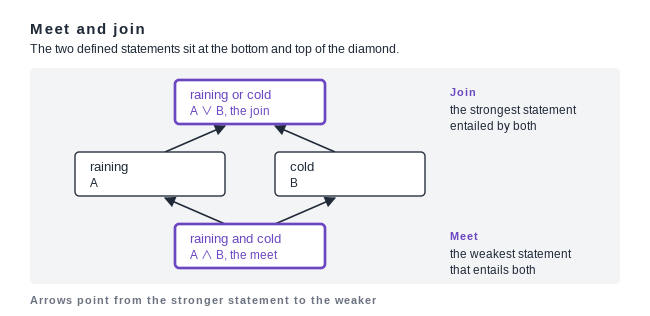
Figure 1. Meet and join in an ordering by entailment. Arrows point from the stronger proposition to the weaker. Purple marks the two defined propositions.
These definitions use the ordinary words "and" and "if and only if" in the sentences that state them. They do not explain "and" to someone who lacks it. They say which element of the ordering deserves the name.
Three orderings
Now supply an ordering. The same two definitions work each time; only the set of propositions changes.
Sets of states (classical). Let Ω be the set of possible states. A proposition is the set of states in which it holds, and entailment is inclusion: A ≤ B means A ⊆ B. Then A ∧ B = A ∩ B and A ∨ B = A ∪ B, and "not A" is the complement Ω \ A. These form a Boolean algebra. Intersection distributes over union, A ∩ (B ∪ C) = (A ∩ B) ∪ (A ∩ C), and "A or not A" is everything.
Open sets (intuitionistic). Let X be a topological space and let propositions be its open sets. Meet is intersection and join is union again, but the complement of an open set is closed, not open. The natural negation is the largest open set that misses A, the interior of the complement:
¬A = int(X \ A).
Take X to be the real line and A = (0, ∞). Then ¬A = (−∞, 0), and A ∨ ¬A is the line with the single point 0 removed, which is not the whole line. The point 0 lies in neither A nor the interior of its complement, so "A or not A" fails to cover everything. This is a fact about the mathematical structure of the semantics. It does not say that something physical is uncertain at 0. The open sets form a Heyting algebra, the algebra that goes with intuitionistic logic (Heyting 1930; the topological reading is due to Tarski 1938).
Subspaces (quantum). Take a Hilbert space and let propositions be its closed subspaces, as in Birkhoff and von Neumann (1936). Entailment is inclusion again, meet is intersection, and join is the closed span of the union. "Truth" here needs a sentence. For a pure state, a proposition is true when its state vector belongs to the corresponding subspace. More generally, a sharp measurement proposition is certain when its projector has probability one; for a mixed state with density operator ρ and projector P, that means Tr(ρP) = 1. Negation is the orthogonal complement A⊥, the states perpendicular to every state in A. It is not the set-theoretic complement, which is not a subspace. These propositions form an orthomodular lattice.
The join is not a union. In the photon plane, let U and D be the two perpendicular diagonal lines. Their join is the whole plane, and a horizontally polarized photon lies in it while lying in neither U nor D. This is the second consequence of the earlier article. The join is certain for a measurement along U and D, since one of the two outcomes must occur. It does not say the photon already possessed one of the two properties.
The map
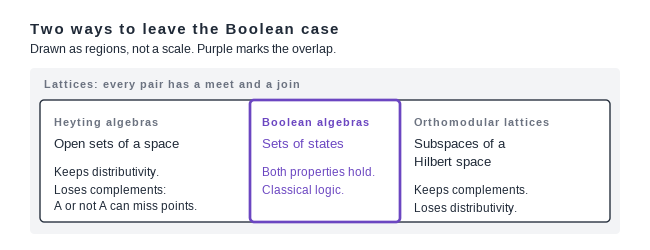
Figure 2. Two ways to depart from a Boolean algebra, drawn as overlapping regions rather than a scale. Purple marks the overlap, the classical case.
Every Boolean algebra is both a Heyting algebra and an orthomodular lattice. The other two structures leave it in different directions:
- A Heyting algebra keeps distributivity and gives up complements. "A and not A" is always empty, but "A or not A" need not be everything.
- An orthomodular lattice keeps complements and gives up distributivity. "A or not A" is always everything, but "and" no longer distributes over "or".
A lattice that is both distributive and orthomodular is Boolean, because a distributive lattice in which every element has a complement is Boolean. So the two departures are independent, and classical logic is where they meet.
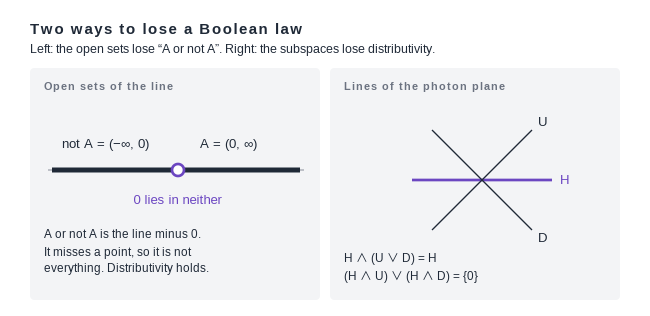
Figure 3. Each departure shown by one example. Left: the open sets of the line lose "A or not A". Right: the lines of the photon plane lose distributivity.
The quantum failure is the one from the earlier articles. With H the horizontal line and U, D as above, U ∨ D is the whole plane, so H ∧ (U ∨ D) = H. But H ∧ U and H ∧ D are both {0}, so (H ∧ U) ∨ (H ∧ D) = {0}.
Where the truth table comes from
In the classical case the truth table can be derived. A state ω in Ω assigns to every proposition a value, true if ω is in A and false otherwise. Then ω is in A ∩ B exactly when ω is in A and ω is in B, which is the table for "and", and likewise for "or" and "not". A truth assignment is a map to {true, false} that respects meet and join and sends the bottom proposition to false and the top to true. A Boolean algebra of sets has plenty of them.
The subspace lattice has none. Take three distinct lines L1, L2, L3 in a plane. Any two have meet {0} and join the whole plane. An assignment that respects meet and join must make exactly one of any two of them true. With three lines that is impossible: if L1 is true, the other two are false, and then the pair L2, L3 has none true. So no assignment of definite truth values to all subspace propositions respects every meet and join.
This impossibility is not the Kochen–Specker theorem, and it should not be confused with it. It concerns assignments that preserve every lattice meet and join, which is a strong requirement, and it already fails in two dimensions. The valuations in the Kochen–Specker theorem ask less, only that the values fit together for orthogonal propositions, and they yield a no-go result only in Hilbert spaces of dimension at least three. A single qubit admits assignments of that weaker kind. Nor is the argument above a claim about physics: it is an algebraic impossibility concerning globally structure-preserving truth assignments, and it does not by itself establish a physical impossibility of hidden variables.
This is the precise sense of the earlier warning. The quantum "or" is the join, and it should not be read as "one of two properties already holds".
Implication
Now the second kind of implication can be added. A → B, as opposed to the relation A ≤ B, is a proposition inside the language. In a Heyting algebra the two are linked by an adjunction:
C ∧ A ≤ B if and only if C ≤ (A → B).
So A → B is the greatest proposition C such that C and A together entail B. In the open sets, the formula is
A → B = int((X \ A) ∪ B),
with the interior taken of the whole union. Taking it of X \ A alone would give a different set. For A = (0, 1) and B = (0, 2) the correct formula gives the whole line, as it must since A ⊆ B, while int(X \ A) ∪ B leaves out the point 0. In a Boolean algebra, A → B is ¬A ∨ B.
An orthomodular lattice cannot have such an operation unless it is Boolean. If meeting with A has a right adjoint, it preserves joins, and that says exactly that (B ∨ C) ∧ A = (B ∧ A) ∨ (C ∧ A): distributivity. The photon plane breaks it, so no implication of this kind exists for subspaces.
Quantum logicians use other operations instead. The best known is the Sasaki hook:
A →S B = A⊥ ∨ (A ∧ B).
It is a possible quantum implication, but it satisfies an adjunction with a different operation, the Sasaki projection, and not with the meet. Whether it deserves the name "implication" is disputed.
An aside for readers who know category theory. The Heyting adjunction is the pattern that characterizes a function type A → B in a programming language. A Heyting algebra is an ordering with meets in which implication plays the role of that function type, which is the order-theoretic shadow of the correspondence between proofs and programs.
Does physics choose the lattice?
In classical mechanics a proposition about a system is naturally a subset of phase space. In quantum mechanics a sharp measurement proposition is naturally a closed subspace. So the physical theory helps choose the representation.
It does not follow that the reasoning about these structures changes. The facts above, including the failure of distributivity, were proved with ordinary classical reasoning about sets and vector spaces. The non-Boolean structure belongs to the algebra of measurement propositions, not necessarily to the metalanguage used to study it. The earlier article made the same point: this is not an experiment refuting classical logic.
Compatible propositions, those that can be measured together, correspond to commuting projectors, and commuting projectors generate a Boolean sub-algebra of the subspace lattice. Within such a "classical window" the logic is exactly classical, not approximately. The classical behaviour of everyday objects needs further physical ideas, including decoherence and limits of large systems, and is not a consequence of the lattice alone.
What has and has not been shown
- Shown. "And" and "or" can be defined from the ordering by entailment alone, as meet and join, wherever the ordering has them. Sets, open sets and subspaces supply such orderings, with the departures from the Boolean case described above.
- Not shown. That every logic has a lattice semantics. The three structures here are not an exhaustive list: relevance logics, for example, do not fit this picture in a simple way.
- Not shown. That the subspace lattice is the correct logic for reasoning in general. Whether it revises logic or only describes the bookkeeping of measurements is disputed.
- Not shown. That the lattice structure fixes every rule. It fixes "and" and "or" and leaves implication and negation open.
The remaining problem
We moved from truth tables to a more abstract principle, but the foundational question is still there. Why should propositions be ordered by entailment? Why should "and" and "or" be greatest lower and least upper bounds? Why should rational reasoning respect this structure at all?
Part of the answer is that meet and join capture the roles that "and" and "or" play in inference. But that explanation assumes that we reason by those roles. This is the point of Carroll's Tortoise in the earlier article, who accepts "A" and "if A then B" but declines to conclude B. At some point a rule is used, not stated. An ordering by entailment is a clean way to describe the rules, and it does not give a reason for following them.
Open questions. Does the choice among Boolean, Heyting and orthomodular orderings depend only on the subject matter, or also on what we want a "proposition" to do? What would it mean for the order of entailment itself to be justified, rather than assumed?
References
- G. Birkhoff and J. von Neumann, "The logic of quantum mechanics", Annals of Mathematics, 2nd series, 37(4) (1936) 823–843.
- A. Heyting, "Die formalen Regeln der intuitionistischen Logik I", Sitzungsberichte der Preußischen Akademie der Wissenschaften, Physikalisch-Mathematische Klasse (1930) 42–56.
- A. Tarski, "Der Aussagenkalkül und die Topologie", Fundamenta Mathematicae 31 (1938) 103–134.
- S. Kochen and E. P. Specker, "The problem of hidden variables in quantum mechanics", Journal of Mathematics and Mechanics 17(1) (1967) 59–87.
- B. A. Davey and H. A. Priestley, Introduction to Lattices and Order, 2nd ed. (Cambridge: Cambridge University Press, 2002).
- L. Carroll, "What the Tortoise said to Achilles", Mind 4(14) (1895) 278–280.
- A. Hindy, “Why ‘Or’ Works Differently in Quantum Mechanics”, keep2learning.com (2026), https://keep2learning.com/articles/quantum-logic-hilbert-space-vs-sets/.
- A. Hindy, “What Makes a Logical Step Valid?”, keep2learning.com (2026), https://keep2learning.com/articles/what-makes-a-logical-step-valid/.