Article · Physics
Three Prices of a Bit
Switching a circuit, erasing information and sending a message each cost energy, and each cost answers a different question.
One bit, three bills
A bit can take one of two values: 0 or 1. A computer switches bits, changing the voltage on small parts of its circuits. It erases them, resetting memory so it can be used again. And it sends them, along a wire or through the air, where noise tries to garble them. How much energy each job needs is a separate question, answered in turn by circuit theory, thermodynamics and information theory.
A few terms come first. Energy is measured in joules (J). The letter T stands for temperature counted from absolute zero, in kelvin; room temperature is about 300 kelvin. The letter k is Boltzmann's constant, a fixed number that links temperature to energy. The product kT sets the characteristic scale of thermal energy, the energy associated with random thermal motion. At room temperature it is about 4.1 × 10⁻²¹ J. Finally, ln 2, about 0.693, is the natural logarithm of 2. It turns up here because a bit has two possible values.
The map
Figure 1 places the three prices side by side. The first card gives the energy used by one example circuit element. The other two give limits, floors that hold under stated conditions: one on the heat released by erasing, the other on the signal energy that arrives at a receiver. The two floors come to the same number, but they limit different things. Switching and erasing are different operations too, so setting the first card beside the second only gives a sense of scale.
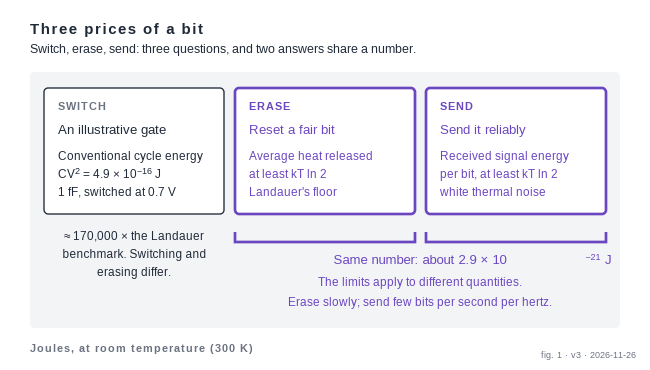
Figure 1. Three questions about the energy of a bit, at 300 kelvin.
Price one: switching a gate
A capacitor stores electric charge. Its capacitance, C, says how much charge it holds for each volt across it. Charged to a voltage V, it stores energy ½CV². The gates of a chip (its basic switching circuits) and the wires between them act as small capacitors.
Connect an empty capacitor, through any resistance, to a supply held at voltage V. The supply delivers an amount of charge CV, all of it at voltage V, so it delivers energy CV². The capacitor ends up storing only ½CV². The other half has become heat in the resistance. This accounting never uses the size of the resistance: a larger one slows the charging but leaves the total heat unchanged.
In an ordinary circuit the capacitor is later drained through a resistance, and the stored half becomes heat too. One full charge and discharge therefore costs CV². This is why the switching power of a chip grows with CV² times the number of such cycles each second.
Take an illustrative gate with a capacitance of 1 femtofarad (10⁻¹⁵ farad), switched at 0.7 volt. One conventional cycle uses CV² = 4.9 × 10⁻¹⁶ J.
Patience lowers the heat
The heat comes from applying the full voltage at once, while the capacitor is still empty. If the supply voltage instead rises gradually, staying close to the capacitor's own voltage, little is lost on the way. The simplest case is a constant current that fills the capacitor in a time t. Call the product RC, resistance times capacitance, the circuit's time constant: its characteristic charging time. The heat lost while charging is then (RC / t) × CV². Figure 2 shows this.
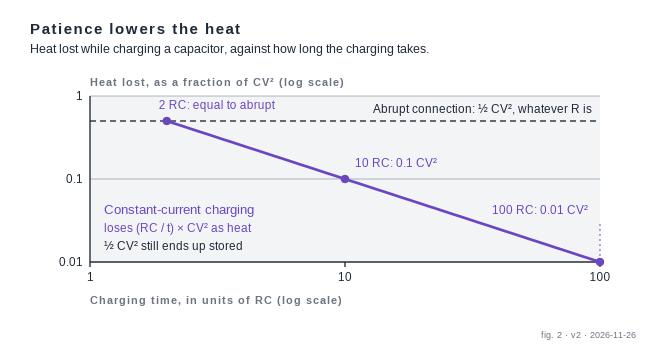
Figure 2. Heat lost while charging at constant current, compared with abrupt connection. Both scales are logarithmic: equal steps mean equal multiplications.
When t is two time constants, constant-current charging loses ½CV², the same as abrupt connection. At ten time constants the loss is 0.1 CV², a fifth of the abrupt loss. At a hundred it is 0.01 CV², a fiftieth. A supply voltage that rises steadily behaves much the same way.
Slow charging reduces the heat lost along the way, but the capacitor still ends up holding ½CV². To bring the loss over the whole switching cycle close to zero, the circuit must also recover that stored energy during discharge and use it again. Experimental and specialised circuits are built to do this (adiabatic or charge-recovery logic). They have not replaced ordinary chips, because they typically need more transistors, more complicated timing signals and more chip area, and they run slower. Those are engineering costs, not a law of physics.
Price two: erasing a bit
In 1961 R. Landauer pointed out a different bill. To erase a bit is to reset it to 0 whatever it held before, so that two possible pasts end in one state. In the standard case, the bit is initially equally likely to be 0 or 1. Resetting it releases at least kT ln 2 of heat to the surroundings, on average.
The reason is entropy, a measure of uncertainty about which state a thing is in. In natural units, the information entropy of a fair bit is ln 2. The corresponding physical entropy is k ln 2. Erasure removes that entropy from the bit, and the second law of thermodynamics requires at least as much to appear in the surroundings. At temperature T, that means heat of at least T × k ln 2. At 300 kelvin this is 2.87 × 10⁻²¹ J.
Both conditions matter. The floor applies to the average: random thermal kicks let a single erasure release less, but the mean over many erasures cannot go below it. And a bit that is almost certainly 0 already carries less uncertainty than a fair bit, so its floor is lower. Steps that lose no information, such as flipping a bit, swapping two bits, or copying a bit into a cell known to be blank, have no such floor in principle.
In 2012 Bérut and colleagues tested the law using a tiny bead, held by laser light in one of two places, as the bit. The two places started out equally likely. As the erasure was made slower, the average heat approached kT ln 2.
The gap above the benchmark
Now compare the first two cards. For this illustrative gate, a conventional charge–discharge cycle uses about 170,000 times the Landauer benchmark. Switching and erasure are different operations, since switching a gate need not destroy any information. Landauer's number serves here only as a yardstick.
Bérut and colleagues quoted about 1,000 times the Landauer limit for silicon logic in 2012.¹ Such ratios depend on the device, its operating voltage and what counts as an operation. The 170,000 figure here belongs to the specified example: a full charge–discharge cycle on a capacitance of 1 femtofarad at 0.7 volt.
Why is the example gate so far above the benchmark? A real gate must switch quickly and reliably despite thermal noise, using imperfect transistors and wires, with room for error, while driving other parts of the circuit. Chip makers also could not keep lowering the voltage, because leakage (current that flows when a transistor is meant to be off) and reliability limits got in the way.
Thermal noise on this one capacitor does not explain the gap by itself. Thermal motion makes its voltage jitter by a typical amount √(kT / C), about 2 millivolts here, while the swing from 0 to 1 is 0.7 volt, about 340 times larger. A margin that wide points to the other requirements as well.
Price three: sending a bit
A channel carries a signal from a sender to a receiver. The standard model assumes noise that simply adds to the signal, has equal power at every frequency the channel uses, and takes random values that follow a bell curve. This is called additive white Gaussian noise. The bandwidth, B, is the width of the range of frequencies in use, measured in hertz (cycles per second).
Two points fix what is being priced. The energy counted is the signal energy that arrives at the receiver for each bit of information. It leaves out the energy used by the transmitter's electronics, by the receiver and by decoding. And reliable communication near the limit needs codes, which spread each message over long stretches of signal so that errors can be corrected. It does not mean that one isolated bit can be read almost perfectly with that little energy.
For this model, Claude Shannon showed that the highest rate of reliable communication, in bits per second, is B log₂(1 + S/N). Here S is the received signal power (energy per second), N is the noise power within the bandwidth, and log₂ is the logarithm to base 2. To turn this into an energy, write E for the energy per bit and N₀ for the noise power in each hertz. Then S is E times the bits per second, and N is N₀ times B. Put these into the formula and write η for the number of bits per second per hertz. Combining these relationships gives the least energy:
Figure 3 plots this ratio. At one bit per second per hertz it is 1, and at two it is 1.5. As η shrinks, the ratio falls toward ln 2, about 0.693, and no further. At η = 0.01 it is within half a percent of that floor.
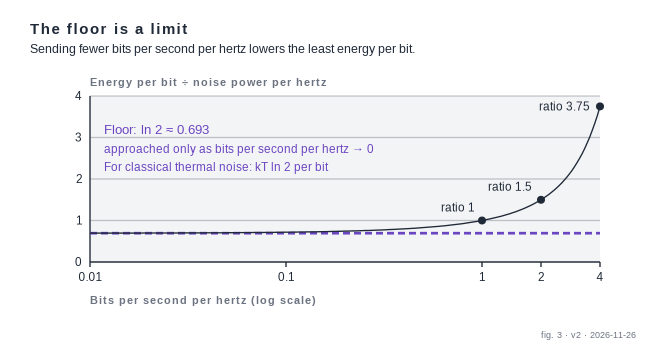
Figure 3. Least received energy per bit for reliable sending, divided by the noise power per hertz. The horizontal scale is logarithmic.
The communication limit is approached as fewer bits are sent per second per hertz—by using more bandwidth, sending more slowly, or both. At a fixed number of bits per second, this takes ever more bandwidth. At a fixed bandwidth, it means lowering both the bit rate and the signal power.
Thermal motion supplies such noise. In the classical approximation, the thermal noise power per hertz is N₀ = kT (the Johnson–Nyquist noise of 1928). The floor then reads E ≥ kT ln 2. This approximation needs quantum corrections at sufficiently high frequencies or low temperatures.
Same number, different limits
The matching numbers do not make the two bounds interchangeable. Landauer limits the average heat released by erasure. Shannon limits the received signal energy needed for reliable communication in the stated noise model. Both contain the thermal energy scale kT and the factor ln 2 associated with binary information, but their derivations concern different physical processes.
Back to the map
Each of the three can use less energy if we give up some speed or, in sending, use more bandwidth. For the illustrative gate, a conventional charge–discharge cycle uses CV², about 170,000 times the Landauer benchmark. Slower charging from a gradually rising supply reduces the loss over a full cycle even if the capacitor is discharged normally. Recovering the stored energy as well allows the cycle's loss to approach zero.
Erasing a fair bit releases at least kT ln 2 of heat on average, a floor approached by erasing ever more slowly. Sending a bit reliably through classical thermal noise takes at least kT ln 2 of received signal energy, a floor approached with fewer bits per second per hertz. Capacitance and voltage set the conventional price of the gate, while temperature sets the two floors. The first price is the cost of one way of building a circuit. The other two limit different processes that happen to share a number.
Endnote
¹ Comparing published ratios. Bérut and colleagues cite studies by Frank and by Pop, which use different energy conventions and benchmarks. Both studies graph energies for transistors, and the readings below are approximate.
- Frank, Figure 6 plots a transistor's minimum switching energy, ½CV², in units of kT, computed from the goals of an industry roadmap, so its 2012 value is a forecast. It has two curves, labelled High and Low. Interpolating on the logarithmic scale between the points for 2011 and 2014 gives, at 2012, about 2,000 kT on the High curve and 1,450 kT on the Low curve. Dividing by ln 2 gives about 2,900 and 2,100 times kT ln 2.
- Pop, Figure 1a marks a point for 2006 at about 2 × 10⁻¹⁷ J, which at 300 kelvin is about 7,000 times kT ln 2. The caption's comparison, “over 1000x”, is with a different benchmark, about 3kT, or some four times kT ln 2.
The example in this article counts CV², twice Frank's convention. Turning an energy into a capacitance also needs a voltage. If one assumes 0.7 volt, Frank's two 2012 values correspond to about 34 and 25 attofarads, where 1 femtofarad is 1,000 attofarads. A different assumed voltage would give a different capacitance.
References
- R. Landauer, "Irreversibility and heat generation in the computing process", IBM Journal of Research and Development 5(3) (1961) 183–191.
- A. Bérut, A. Arakelyan, A. Petrosyan, S. Ciliberto, R. Dillenschneider, E. Lutz, "Experimental verification of Landauer's principle linking information and thermodynamics", Nature 483 (2012) 187–189.
- M. P. Frank, "The physical limits of computing", Computing in Science & Engineering 4(3) (2002) 16–26. Published scan.
- E. Pop, "Energy dissipation and transport in nanoscale devices", Nano Research 3(3) (2010) 147–169. arXiv:1003.4058.
- C. E. Shannon, "A Mathematical Theory of Communication", Bell System Technical Journal 27(3) (1948) 379–423 and 27(4) (1948) 623–656.
- MIT OpenCourseWare, 6.451 Principles of Digital Communication II (Spring 2005), chapter 4, section 4.2.
- J. B. Johnson, "Thermal agitation of electricity in conductors", Physical Review 32 (1928) 97–109; H. Nyquist, "Thermal agitation of electric charge in conductors", Physical Review 32 (1928) 110–113.
- A. R. Kerr and J. Randa, "Thermal noise and noise measurements—a 2010 update", IEEE Microwave Magazine 11(6) (2010) 40–52.